Geography and governance
1. Autonomous status and the IWC
The Faroe Islands are a self-governing part of the Kingdom of Denmark with authority over fisheries and whaling, while Denmark represents the kingdom in international organizations like the IWC; because the Faroes are not individually bound by Denmark’s anti-whaling stance, they can legally continue the Grindadráp under their own domestic law. Wikipedia Library of Congress Blogs
Source: Whaling in the Faroe Islands – Wikipedia Wikipedia; FALQs: What Rules Govern the Grindadráp? – Library of Congress Library of Congress Blogs
2. Non‑membership in the EU and impact on the Grindadráp
The Faroe Islands are not part of the European Union, unlike Denmark, largely due to fisheries policy and a desire to retain control over marine resources; this exemption from EU law means EU wildlife and habitat protections do not directly apply, giving the Faroese more regulatory freedom to maintain the Grindadráp. Wikipedia Library of Congress Blogs
Source: Whaling in the Faroe Islands – Wikipedia Wikipedia; FALQs: What Rules Govern the Grindadráp? Library of Congress Blogs
3. Danish logistical or military support (Arctic Command)
Formally, defense and foreign affairs remain under Copenhagen, and the Joint Arctic Command is responsible for surveillance and search‑and‑rescue around the Faroes; however, the Grindadráp itself is organized and executed by local Faroese authorities, with Danish military assets not normally deployed as operational support for the hunts, except indirectly through general maritime presence and safety functions. Library of Congress Blogs
Source: FALQs: What Rules Govern the Grindadráp? Library of Congress Blogs
4. Differences among the 23 authorized whaling bays
Faroese regulations list specific “authorized whaling bays” where drives may occur; these bays differ in size, shelter, seabed slope, and proximity to settlements, which affects how often they are used—some, like those near larger towns, see more frequent hunts, while remote or less suitable bays are used rarely. Wikipedia Library of Congress Blogs
Source: Whaling in the Faroe Islands – Wikipedia Wikipedia; FALQs: What Rules Govern the Grindadráp? Library of Congress Blogs
5. Constitutional relationship and diplomatic pressure
Because the Faroes are a self‑governing territory within the Danish Realm, international criticism is often directed at Denmark, yet Copenhagen cannot unilaterally abolish the Grindadráp without renegotiating the Home Rule/ Self‑Government framework; this split competence blurs responsibility and complicates diplomatic efforts to pressure either capital into ending the hunts. Library of Congress Blogs
Source: FALQs: What Rules Govern the Grindadráp? Library of Congress Blogs
Culture and history
6. Historical origins and Viking‑Age survival
The Grindadráp dates back at least to the 9th century, when Norse settlers relied on opportunistic whale drives as a crucial protein source in a harsh sub‑Arctic environment with limited agriculture, helping communities survive winters and crop failures. Wikipedia
Source: Whaling in the Faroe Islands – Wikipedia Wikipedia
7. Meat distribution and “non‑commercial” character
By law and tradition, the meat and blubber are divided among local participants and residents, with no formal commercial sale; this communal distribution historically functioned as a food‑security buffer, ensuring that even poorer households received nutrient‑dense food during times of scarcity. Wikipedia Library of Congress Blogs
Source: Whaling in the Faroe Islands – Wikipedia Wikipedia; FALQs: What Rules Govern the Grindadráp? Library of Congress Blogs
8. From rowing boats to speedboats and sonar
The hunt has evolved from small rowing boats and hand‑thrown stones or noise‑making devices to modern motorboats, radios, and sometimes echo‑sounders to locate pods more efficiently, while the on‑shore killing tools have been updated to meet animal‑welfare regulations. Wikipedia Library of Congress Blogs
Source: Whaling in the Faroe Islands – Wikipedia Wikipedia; FALQs: What Rules Govern the Grindadráp? Library of Congress Blogs
9. “Free‑range” meat versus industrial imports
Many Faroese argue that pilot whales live natural lives in the open ocean and are killed without long‑term confinement, contrasting this with imported industrial meat from intensive farms; this framing allows them to see whale meat as ethically preferable “free‑range” protein despite international criticism. Wikipedia
Source: Whaling in the Faroe Islands – Wikipedia Wikipedia
10. Symbol of national identity and resistance to “cultural imperialism”
The Grind is often portrayed locally as a core element of Faroese culture and self‑determination, so foreign campaigns to end it are sometimes interpreted as outsiders imposing their values; defending the hunt thus becomes a way to assert national identity against perceived Western or metropolitan cultural imperialism. Wikipedia Library of Congress Blogs
Source: Whaling in the Faroe Islands – Wikipedia Wikipedia; FALQs: What Rules Govern the Grindadráp? Library of Congress Blogs
11. Role of Grind foremen and knowledge transfer
“Grind foremen” (grindformenn) coordinate the drive, decide whether conditions are safe, and direct boats and shore crews; their expertise—boat handling, reading whale behavior, and applying regulations—is passed down informally through family participation and community practice, reinforced today by formal training requirements. Library of Congress Blogs
Source: FALQs: What Rules Govern the Grindadráp? Library of Congress Blogs
Biology and environment
12. Long‑finned pilot whale vs. Atlantic white‑sided dolphin
Long‑finned pilot whales are larger, deep‑diving oceanic dolphins (genus Globicephala) with strong social structures, while Atlantic white‑sided dolphins are smaller, faster coastal‑oceanic dolphins (Lagenorhynchus acutus); both species travel in groups that can be herded into bays and yield edible meat and blubber, which is why they are targeted in drives. Wikipedia
Source: Whaling in the Faroe Islands – Wikipedia Wikipedia
13. Biological sustainability of 600–1,000 whales per year
Average annual catches of around 700 pilot whales are often described by Faroese authorities as sustainable relative to North Atlantic population estimates, though independent scientists debate uncertainties in stock structure and cumulative impacts; there is no consensus that current removals are biologically harmless, only that they are likely below catastrophic levels for the wider population. Wikipedia
Source: Whaling in the Faroe Islands – Wikipedia Wikipedia
14. Drive method, stress, and physiology
The drive method involves prolonged pursuit, noise, and crowding, which can cause acute stress responses in highly social cetaceans—elevated cortisol, tachycardia, and disorientation—before stranding and killing; critics argue this undermines welfare even if the final killing stroke is rapid. Wikipedia
Source: Whaling in the Faroe Islands – Wikipedia Wikipedia
15. Ecological consequences of removing whole pods
Removing entire matrifocal pods can disrupt local social structures, knowledge transmission (such as migration routes and foraging sites), and potentially alter predator–prey dynamics in specific regions, even if the overall population remains numerically stable; such social depletion effects are difficult to quantify but are a key concern in conservation biology. Wikipedia
Source: Whaling in the Faroe Islands – Wikipedia Wikipedia
16. Climate change and migration near the Faroes
Warming seas and shifting prey distributions in the North Atlantic are likely influencing where and when pilot whales encounter the Faroes, potentially altering drive frequency and locations over time, though long‑term, fine‑scale migration changes remain imperfectly documented. Wikipedia
Source: Whaling in the Faroe Islands – Wikipedia Wikipedia
Health and toxicology
17. Why pregnant women are advised not to eat whale meat
Faroese health authorities have recommended that women who are pregnant, planning pregnancy, or breastfeeding avoid pilot whale meat and blubber because of high levels of methylmercury and persistent organic pollutants (including PCBs), which can cross the placenta and affect fetal development. Wikipedia
Source: Whaling in the Faroe Islands – Wikipedia Wikipedia
18. Long‑term neurological effects of methylmercury and PCBs
Chronic exposure to methylmercury is associated with neurodevelopmental deficits in children—reduced IQ, attention problems, and motor impairment—while PCBs are linked to endocrine disruption and possible carcinogenic effects; cohort studies in the Faroes have documented subtle but measurable neurological impacts correlated with whale‑meat consumption. Wikipedia
Source: Whaling in the Faroe Islands – Wikipedia Wikipedia
19. Changing popularity among younger Faroese
As toxicology findings and official warnings have become widely known, younger Faroese tend to eat whale meat less frequently, and some reject it altogether, contributing to a gradual decline in per‑capita consumption even as the cultural symbolism of the Grind remains strong. Wikipedia
Source: Whaling in the Faroe Islands – Wikipedia Wikipedia
20. The “mercury paradox”
The Faroes exemplify a “mercury paradox”: a traditional, identity‑laden food that is culturally valued yet biologically hazardous, forcing communities to choose between heritage and health or to re‑interpret tradition in light of modern toxicology. Wikipedia
Source: Whaling in the Faroe Islands – Wikipedia Wikipedia
Legal and ethical debates
21. The spinal lance and loss of consciousness
The spinal lance is a specialized tool inserted behind the blowhole to sever the spinal cord and major blood vessels; regulations and training emphasize its use to induce rapid loss of consciousness and death, reducing the time animals remain aware compared with older methods. Library of Congress Blogs
Source: FALQs: What Rules Govern the Grindadráp? Library of Congress Blogs
22. Activist groups vs. diplomatic NGOs
Groups like Sea Shepherd focus on direct action, documentation, and media campaigns—using boats, shore teams, and now drones to expose hunts—whereas diplomatic NGOs typically work through lobbying, legal analysis, and multilateral forums to pressure Denmark and the Faroes to change policy. Sea Shepherd Conservation Society Library of Congress Blogs
Source: Sea Shepherd – Pregnant Pilot Whales and Calves Slaughtered in Faroe Islands Hunt Sea Shepherd Conservation Society; FALQs: What Rules Govern the Grindadráp? Library of Congress Blogs
23. Impact of the 2021 dolphin slaughter (1,400+ dolphins)
The 2021 drive that killed over 1,400 Atlantic white‑sided dolphins triggered intense international backlash and internal debate, leading Faroese authorities to review regulations and later introduce stricter limits and permitting requirements for dolphin hunts, even as pilot‑whale drives continued. Wikipedia Library of Congress Blogs
Source: Whaling in the Faroe Islands – Wikipedia Wikipedia; FALQs: What Rules Govern the Grindadráp? Library of Congress Blogs
24. Mandatory whaling course (2025/2026)
Current Faroese law requires participants in the killing phase to complete a certified whaling course covering anatomy, use of the spinal lance, and animal‑welfare rules; only those with valid certification may perform the killing, and authorities can suspend hunts if these standards are not met. Library of Congress Blogs
Source: FALQs: What Rules Govern the Grindadráp? Library of Congress Blogs
25. Significance of the 2025 animal‑abuse charges
The first‑ever animal‑abuse charges—stemming from a 2024 drive where whales were allegedly left suffering in shallow water—marked a historic legal turning point, prompting regional suspensions of hunts and signaling that Faroese courts may now treat regulatory breaches as criminal cruelty rather than mere administrative issues. Oceanographic Magazine reefdivers.io
Source: Unprecedented animal abuse case halts Faroe Islands’ Grindadráp – Oceanographic Oceanographic Magazine; Faroe Islands Confront Whale-Hunt Controversy in Court – ReefDivers reefdivers.io
26. Subsistence hunting or ritual slaughter under international law
Internationally, the Grindadráp sits in a grey zone: it has subsistence roots and still provides food, but today occurs in a high‑income society with alternative protein sources and strong symbolic overtones, so some legal scholars argue it resembles “ritual slaughter,” while Faroese authorities frame it as culturally embedded, small‑scale subsistence whaling. Library of Congress Blogs
Source: FALQs: What Rules Govern the Grindadráp? Library of Congress Blogs
Recent trends and the future
27. Drones, activists, and exclusion zones
Activist use of drones to film drives has increased real‑time visibility of the hunts, leading Faroese police to enforce or expand exclusion zones around bays to keep observers and aircraft at a distance, citing safety and public‑order concerns while critics see it as an attempt to limit documentation. Sea Shepherd Conservation Society Library of Congress Blogs
Source: Sea Shepherd – Pregnant Pilot Whales and Calves Slaughtered in Faroe Islands Hunt Sea Shepherd Conservation Society; FALQs: What Rules Govern the Grindadráp? Library of Congress Blogs
28. Internal movement against dolphin hunts
After the 2021 dolphin drive, segments of Faroese society—including some politicians and fishers—have expressed support for restricting or ending dolphin hunts while maintaining pilot‑whale drives, reflecting an internal compromise between cultural continuity and reputational damage. Wikipedia Library of Congress Blogs
Source: Whaling in the Faroe Islands – Wikipedia Wikipedia; FALQs: What Rules Govern the Grindadráp? Library of Congress Blogs
29. Tourism, “pristine nature,” and blood‑red bays
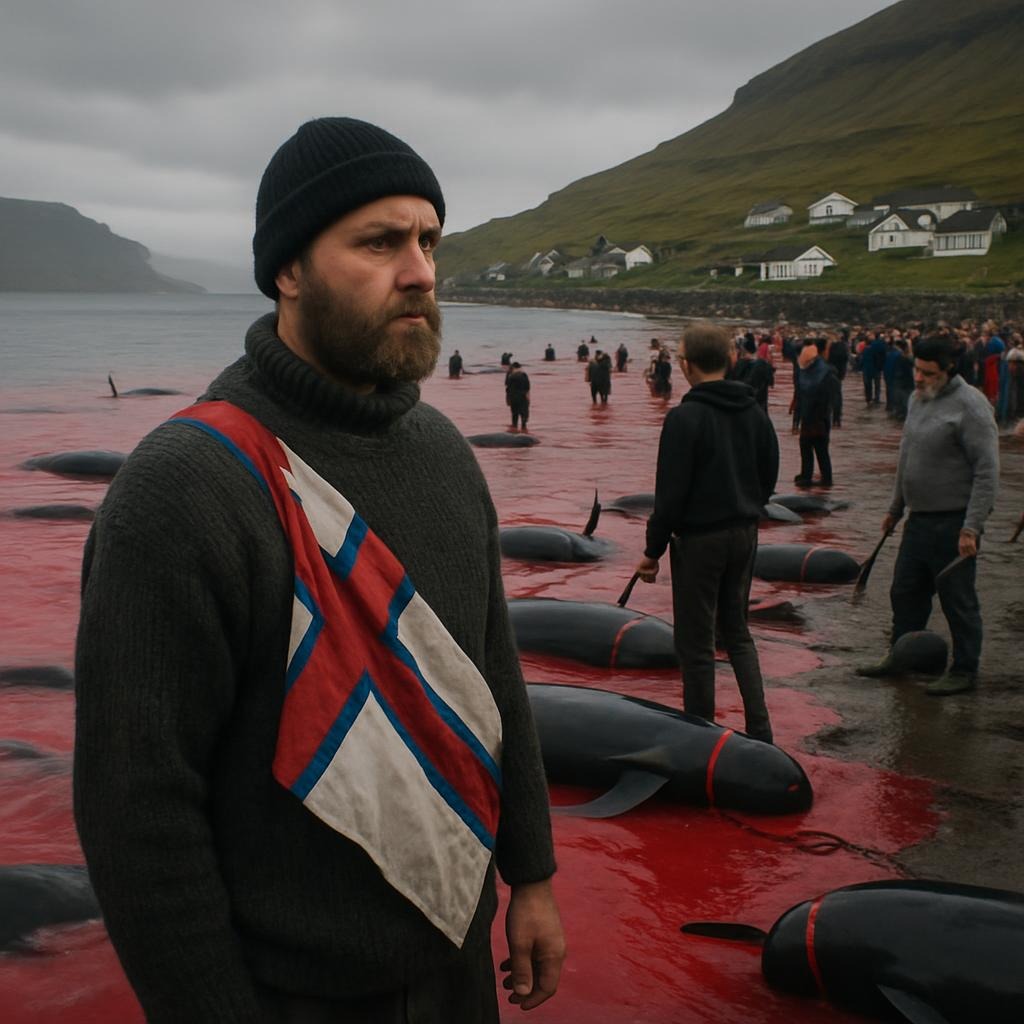
The Faroes market dramatic landscapes and wildlife to tourists, while the Grind’s graphic imagery periodically clashes with that branding; tourism operators often distance their messaging from the hunts or frame them as rare, regulated events, but viral images of red bays periodically undermine the “untouched nature” narrative. Wikipedia Sea Shepherd Conservation Society
Source: Whaling in the Faroe Islands – Wikipedia Wikipedia; Sea Shepherd – Pregnant Pilot Whales and Calves Slaughtered in Faroe Islands Hunt Sea Shepherd Conservation Society
30. Contamination as a possible endgame
If North Atlantic contamination continues to raise levels of mercury and POPs in whale tissues, health‑based advisories may become so strict that regular consumption is socially or medically untenable, potentially eroding the practical basis for the Grindadráp even if legal and cultural defenses remain in place. Wikipedia
Source: Whaling in the Faroe Islands – Wikipedia Wikipedia
Keywords
Keywords: Faroe Islands, Grindadráp, pilot whale, Atlantic white‑sided dolphin, autonomous territory, International Whaling Commission, European Union opt‑out, whaling bays, Arctic Command, Tórshavn–Copenhagen relations, Viking Age subsistence, communal meat distribution, non‑commercial whaling, spinal lance, animal welfare, methylmercury, PCBs, toxicology, Sea Shepherd, drones, exclusion zones, 2021 dolphin hunt, 2025 animal‑abuse case, whaling course, cultural identity, subsistence hunting, ritual slaughter, climate change, North Atlantic pollution, tourism optics.
About the Author