Economic & Trade Defense
1. APEP counters China’s BRI by offering a high-standard, values-based investment alternative focused on transparency and sustainability.
Unlike the Belt and Road Initiative, which often involves state-backed loans, the Americas Partnership for Economic Prosperity (APEP) prioritizes regional supply chain integration, digital economy standards, and clean energy. By late 2025, APEP transitioned into a “high-standard club” that offers preferential financing to nations that adhere to U.S.-aligned labor and environmental rules.
2. “Security-shoring” in Mexico is successfully decoupling electronics and auto supply chains, despite tensions over “America First” tariffs.
While “friendshoring” initially faced hurdles, the shift toward “security-shoring” in 2025 has seen Mexico close over 1,000 “phantom” Chinese steel mills.1 By 2026, Mexico has successfully replaced China as the primary source of many mid-tech components for the U.S. market, though at the cost of higher domestic tariffs.
3. U.S. tariffs of 10-50% on Chinese-made components are forcing Latin American exporters to diversify or face secondary U.S. levies.
Nations like Mexico and Brazil have faced U.S. pressure to raise their own tariffs on Chinese EVs and steel (up to 50%) to prevent “backdoor” entry into the U.S. market.2 This has created a “trade diversion” effect where South American agricultural exports to China have increased, but industrial exports to the U.S. now require strict “Rule of Origin” certification.
4. The U.S. DFC is outbidding Chinese loans by quadrupling its exposure and investing in high-income countries under national security waivers.
Following its 2025 reauthorization, the U.S. International Development Finance Corporation (DFC) now has a mandate to prioritize strategic competition. It has successfully outbid Chinese state banks for projects in Guatemala and Panama by offering equity investments instead of debt-heavy loans.
5. The U.S. Treasury is stabilizing regional currencies, like the Argentine Peso, to reduce reliance on Chinese currency swap lines.
The U.S. has incentivized Latin American nations to reject Chinese credit by offering Treasury-backed currency stabilization funds. In late 2025, the U.S. pressured Argentina to cap its Chinese credit assistance in exchange for massive IMF and U.S. financial support.3
6. The U.S. protects Caribbean nations from economic coercion through increased naval patrols and “Blue Economy” investment packages.
To counter Chinese “gray zone” pressure, the U.S. has deployed naval units to the Caribbean and launched initiatives to support maritime security and sovereign debt management for smaller island nations.
Strategic Infrastructure & Technology
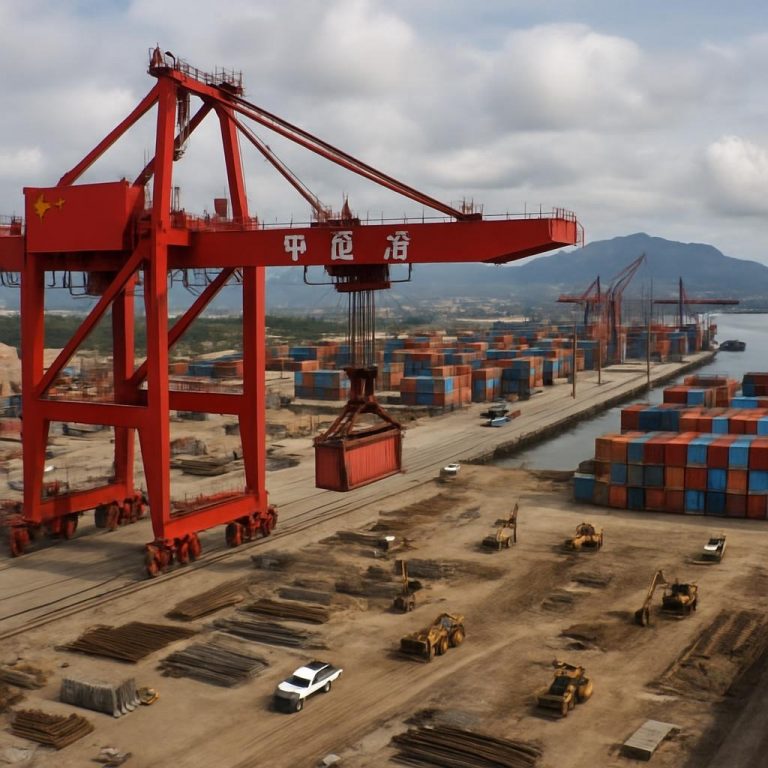
7. The U.S. is countering the Port of Chancay by investing in Chile’s San Antonio port and expanding U.S. port capacity in the Southern Cone.4
The U.S. views the Chinese-built mega-port in Peru as a strategic threat.5 In response, Washington has expedited financing for competing port infrastructure in Chile and Colombia to ensure Western logistics remain competitive.6
8. The U.S. is using AI chip export controls and regional security partnerships to marginalize Huawei and ZTE in 5G rollouts.
The campaign against Chinese 5G has evolved; in 2025, the U.S. focused on China’s role in AI. By restricting Huawei’s access to advanced chips, the U.S. has made Chinese 5G less attractive compared to U.S.-backed Open-RAN and European alternatives.
9. The U.S. uses bilateral space consultations with Argentina to demand transparency and “peaceful use” only for the Neuquén station.
Through the March 2025 U.S.-Argentina Bilateral Space Consultations, Washington has integrated Argentine space efforts into Western frameworks to counter the “military-civil fusion” risk of the Chinese-run monitoring station.
- Source: U.S. Embassy Argentina – Joint Statement on U.S.-Argentina Bilateral Space Consultations (2025)
10. The U.S. used financial pressure to force the sale of Panama Canal port concessions from Chinese firms to U.S. asset managers like BlackRock.7
In a major strategic victory in March 2025, a BlackRock-led consortium purchased the concessions for the Balboa and Cristobal ports from Hong Kong’s CK Hutchison, effectively removing Chinese operational control from the canal’s entrances.8
11. U.S. “Digital Sovereignty” packages offer open-source tech stacks and regional data governance to replace Chinese surveillance tech.
By late 2025, the U.S. began promoting a “Just Digital Order” that emphasizes local control of infrastructure and data, directly competing with the “Safe City” surveillance models exported by Beijing.
12. The Strategic Subsea Cables Act of 2025 empowers the U.S. to monitor and protect internet cables from Chinese espionage and sabotage.9
New FCC rules and bipartisan legislation passed in 2025 restrict foreign adversaries like China from owning or accessing submarine cable landing stations, securing the Southern Hemisphere’s data backbone.10
- Source: Submarine Networks – US FCC Adopts Order to Accelerate Submarine Cable Buildout & Security (2025)
Resource & Energy Security
13. The Minerals Security Partnership (MSP) secures the “Lithium Triangle” by funding midstream refining facilities in Argentina and Chile.
A 2025 partnership between the U.S., UK, and Latin American nations aims to build a Western lithium-ion battery value chain, reducing the region’s dependence on Chinese refining.
14. U.S. financing for Direct Lithium Extraction (DLE) tech prevents a Chinese monopoly by making Western processing more cost-competitive.
By supporting DLE technology, which is faster and more environmentally friendly, the U.S. is helping Argentina and Chile maintain control over their minerals against Chinese state-owned giants.
- Source: Fastmarkets – The Lithium Triangle: Three countries control more than 50% of global resources (2026)
15. The U.S. counters Chinese “food security” land buys by providing agricultural aid and promoting trade with the Global North.
While China has secured massive soy shipments from Brazil, the U.S. has used 2025 tariff revenues to support Western farmers and maintain a strategic foothold in global agricultural markets.11
16. The “Energy Security Compacts” framework supports Latin American nuclear and hydro innovation to bypass Chinese financing.
A September 2025 report highlights U.S. efforts to use interagency coordination to offer Brazil and others cleaner, more reliable energy technologies than those provided by China’s predatory lending.12
Military & Intelligence
17. SOUTHCOM’s mission now prioritizes the “Trump Corollary” to deny non-hemispheric competitors any control over strategically vital assets.13
The “Trump Corollary” (reaffirmed in December 2025) updates the Monroe Doctrine, asserting that only the U.S. and its hemispheric partners should control the security and infrastructure of the Americas.14
18. The U.S. is increasing IMET funding and expanding billets at defense colleges to match China’s “business-class” military student perks.
To counter China’s 119 military exchanges in the region (2022–2025), the U.S. is rethinking its International Military Education and Training (IMET) programs to offer better incentives to Latin American officers.
19. Operation Absolute Resolve demonstrated U.S. domain dominance through the January 3, 2026, capture of Nicolas Maduro in Caracas.15
This high-profile military and law-enforcement operation served to “deny non-hemispheric competitors” (Russia/China) a strategic foothold in Venezuela while asserting absolute U.S. regional authority.
20. The U.S. prevents “dual-use” port conversion by leveraging the Trump Corollary to force the sale of Chinese-held strategic infrastructure.
By designating certain ports as “strategically vital,” the U.S. now uses its national security strategy to block Chinese companies from owning infrastructure that could be converted to naval bases.
21. U.S. intelligence tracks the Chinese “Global Security Initiative” (GSI) to counter the blurring of lines between police and private security.
The U.S. monitors China’s GSI, which packages law enforcement support and surveillance technology as “benign” assistance, as a means of expanding Beijing’s security footprint in the region.
Diplomacy & Soft Power
22. The U.S. incentivizes Taiwan’s remaining partners (Paraguay, Belize, Guatemala) with economic support and leadership roles in multilaterals.16
Washington provides “favorable economic support” to these nations to help them resist Chinese pressure to flip diplomatic recognition.17
23. “Pragmatic Security” aligns U.S. strategy with regional needs, focusing on sovereignty and transparency over idealistic “Democracy Promotion.”
The 2025 National Security Strategy shifts focus to being the “first-choice partner” by ensuring U.S. investments bring high labor standards and technology transfers without the “opacity” of Chinese deals.18
24. The U.S. is funding a “Modern Information Initiative” to empower independent local journalists against CGTN Español’s influence.
Rather than just counter-propaganda, the U.S. supports networks of local influencers who emphasize transparency and the risks of “debt-trap” diplomacy.19
25. The U.S. leverages the Latin American diaspora’s cultural and linguistic ties to build “soft power” resilience against Chinese narratives.
By telling the “American story” through the diaspora, the U.S. aims to reinforce the shared democratic values and cultural proximity that China cannot replicate.
26. The U.S. counters the “Global South” narrative by emphasizing that U.S. partnerships protect “Sovereignty” against “Economic Subjugation.”
Washington’s new messaging frames the U.S. as a defender of national agency, contrasting it with China’s model of “weaponized interdependence.”
Transnational Threats
27. The U.S. coordinates with Mexico to shut down “phantom” industrial sites that facilitate fentanyl precursor flows from China.
In 2025, Mexico began raiding storage buildings used to reroute Chinese goods and chemicals, a move negotiated in exchange for U.S. tariff discounts.
28. U.S. naval patrols in the Caribbean and Southern Atlantic protect against Chinese IUU fishing under the 2025 Monroe Doctrine update.
The U.S. has increased its maritime presence to intercept and deter illegal fishing by massive Chinese fleets, framing it as a violation of regional sovereignty.
29. The U.S. uses migration policy—such as deportation agreements—to pressure governments that lean too heavily toward Beijing.
The Trump administration has used the threat of tariffs and migration restrictions to force countries like Colombia and Mexico to align more closely with U.S. security priorities.
30. U.S. anti-corruption programs target opaque Chinese infrastructure projects to protect regional judicial systems.
The U.S. promotes “judicial and police cooperation” focused on anti-corruption to expose the bribes and lack of transparency often associated with large-scale Chinese BRI projects.
Keywords:
America’s Partnership for Economic Prosperity (APEP), Trump Corollary, Monroe Doctrine, Operation Absolute Resolve, Port of Chancay, Lithium Triangle, Debt-trap Diplomacy, Digital Sovereignty, Strategic Subsea Cables Act, Friendshoring, Security-shoring, Critical Minerals, U.S. Southern Command (SOUTHCOM), China-CELAC Forum, Global Security Initiative (GSI).
About the Author