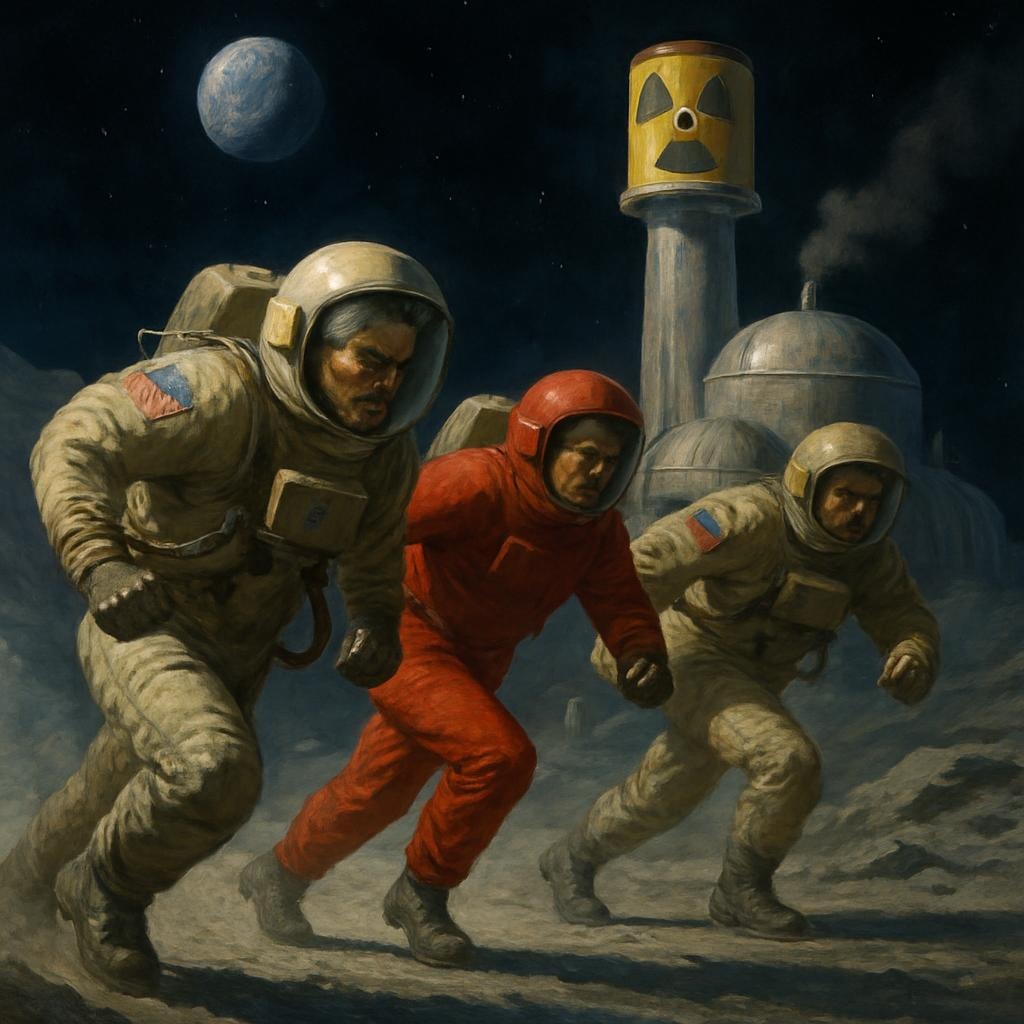
Direct answer: The United States is targeting a fully operational lunar fission reactor by 2030, while the Russia–China ILRS partnership is aiming for around 2035 PBS DW.
Geopolitics and race dynamics
- Target dates for US and Russia–China collaboration:
US: 2030 operational target under NASA’s Fission Surface Power plans. Russia–China (ILRS): Planning a nuclear power station to support the ILRS by about 2035 PBS AVIATION NEWS DW. - First mover influence on norms and standards:
Lead nation: The first to field a functioning lunar reactor will likely shape operational safety practices, deconfliction norms, and soft-law precedents (e.g., safety zones, transparency, notifications) that others emulate or contest, affecting future governance of lunar operations NASA Springer. - Outer Space Treaty articles most relevant:
Article I: Freedom of exploration and use for all. Article II: Non-appropriation (no sovereignty claims). Article IV: Peaceful purposes; prohibits WMDs on celestial bodies. Article VI: International responsibility for national activities (including private actors). Article IX: Due regard and consultations to avoid harmful interference—central to reactor siting and operations UNOOSA Wikipedia en.wikisource.org. - Artemis Accords “safety zones” and de facto claims:
Interpretation risk: Safety zones intended for deconfliction could be perceived as functional exclusivity over sites or resources (e.g., power corridors, ISRU areas), raising concerns under non-appropriation; careful design and transparency are needed to avoid territorial signaling openlunar.org Payne Institute for Public Policy ResearchGate. - Main driver of US timeline:
Geopolitical competition: While technical needs are real (lunar nights, polar darkness), public directives and industry commentary emphasize outpacing China–Russia as a decisive driver behind the accelerated 2030 timeline SpaceNews RFI Fox News. - Role of private companies versus Russia–China model:
US: NASA is leveraging commercial partners (e.g., Lockheed Martin concepts, X-energy advocacy, BWXT/Oklo in broader FSP discourse) within a competitive-contracting framework. Russia–China: ILRS is state-led with intergovernmental agreements and national space agencies coordinating reactor development Power Technology X-energy NASA. - Economic advantages beyond prestige:
ISRU value-chains and helium‑3 narratives: Reliable power enables sustained ISRU (oxygen, fuels, construction), manufacturing and logistics; helium‑3 mining is a long-term speculative incentive often cited, though technical and legal hurdles remain NASA Technical Reports Server (NTRS) Frontiers NASA Technical Reports Server (NTRS) European Space Agency. - Liability in case of accident:
State liability: Under the Liability Convention framework and OST Article VI, the launching state(s) bear international liability for damage; states remain responsible for activities of private entities they authorize and supervise UNOOSA empowerlaws.com decreeon.com. - ILRS nuclear positioning vs NASA Artemis:
ILRS: Aims for an integrated power source for a south‑pole research station with construction phases leading to a 2035 reactor. NASA/Artemis: A modular Fission Surface Power demonstrator powering Artemis Base Camp elements, emphasizing commercial partnerships and scalable architectures DW Interesting Engineering PBS. - Transparency and consultation measures:
Proposals: Accords-aligned commitments to register and notify activities, share locations and operational footprints, establish safety zones publicly, and consult to avoid harmful interference—grounded in OST Article IX and the Accords’ transparency principles NASA openlunar.org UNOOSA.
Technical and engineering challenges
- Waste heat rejection in vacuum:
Challenge: With no convection, reactors must radiate heat via large, lightweight radiators and heat pipes, using variable-conductance designs to handle thermal swings and changing loads Advanced Cooling Technologies isnps.unm.edu American Nuclear Society. - Why fission beats solar/RTGs/fuel cells for bases:
Continuity and power density: Fission provides steady, high power through 14‑day lunar nights and polar shadow periods; RTGs are low-power, and fuel cells need consumables, making them insufficient for sustained operations and ISRU NASA Technical Reports Server (NTRS) MDPI. - Initial power output target:
Range: NASA studies explore 10–40 kWe systems; public directives and reporting frequently cite a 100 kWe class for initial deployment goals NASA Technical Reports Server (NTRS) AVIATION NEWS RFI. - Implications of one‑sixth gravity:
Design impacts: Lower gravity affects fluid behavior in cooling loops, shielding convection, radiator deployment mechanics, and structural support; systems must rely more on capillary/heat-pipe transport and account for altered natural convection performance NASA Technical Reports Server (NTRS) NASA Technical Reports Server (NTRS). - Fuel and coolant preferences:
Likely options: Uranium‑235 fueled compact fission systems with heat-pipe or gas/alkali-metal loops for rejection; lightweight heat‑pipe radiators are receiving design attention for lunar conditions American Nuclear Society Advanced Cooling Technologies NASA Technical Reports Server (NTRS). - Protection from lunar regolith:
Design features: Sealed enclosures, dust-tolerant mechanisms, electrostatic mitigation, standoff mounts, and protective berms/surface treatments to reduce abrasive, electrostatically charged dust ingress and erosion NASA Technical Reports Server (NTRS) MDPI. - Launch/transit nuclear risks and mitigation:
Risks: Launch failure, reentry dispersal, and transport accidents. Mitigation: Robust containment, delayed fueling or safe modes, proven packaging/launch safety analyses; liability and authorization frameworks apply to risk governance empowerlaws.com decreeon.com. - Activation and low‑maintenance operation:
Approach: Pre‑integrated, autonomous startup, passive safety, remote monitoring and control, and minimal crew intervention leveraging automation and fault detection to reduce EVA servicing needs X-energy NASA Technical Reports Server (NTRS). - Operational lifespan target:
Baseline: Design studies and NASA FSP goals aim for multi‑year to decade‑scale continuous service to support a permanent presence, often cited at ~10 years for sustained operations NASA NASA Technical Reports Server (NTRS). - Radiation shielding needs without atmosphere:
Impacts: Shielding must protect habitats from both reactor emissions and space radiation (GCR/SPE). Regolith berms, optimized materials, and storm shelters reduce dose; siting and standoff distances complement reactor shielding design NASA Technical Reports Server (NTRS) AGU Publications NASA Technical Reports Server (NTRS).
Strategic and future vision
- Stepping stone to Mars:
Reason: Lunar fission validates surface power architectures, autonomy, operations, and ISRU logistics essential for Mars, and NASA’s architecture decisions highlight fission for Mars surface power SpaceNews NASA Technical Reports Server (NTRS) NASA. - Primary lunar activities powered:
Focus: Life support, habitat systems, mobility, communications, thermal control, and ISRU (oxygen, fuel production, construction), plus science payloads and manufacturing equipment NASA Technical Reports Server (NTRS) Frontiers. - Environmental concerns on the Moon:
Issues: Site contamination, thermal impacts, debris, and end‑of‑life waste handling; although no biosphere exists, stewardship and cross‑mission interference concerns remain significant MDPI NASA. - Pre‑deployment infrastructure:
Construction: Landing pads, berms, foundations, radiator fields, cable/power distribution, and dust mitigation are expected, built via robotics and ISRU processes like molten regolith electrolysis and sintered regolith structures Defense Advanced Research Projects Agency Defense Advanced Research Projects Agency UPCommons. - Effect on civilian agency strategy and funding:
Shift: Emphasis on commercial partnerships, nuclear surface power lines, and Moon‑to‑Mars alignment; acceleration directives and industry engagement point to reprioritization toward strategic lunar infrastructure SpaceNews SpaceNews. - Renewed interest in space nuclear propulsion:
Link: Success of lunar fission could catalyze investment and confidence in nuclear thermal propulsion for cislunar logistics and Mars transfer systems, as agencies and industry highlight synergies NASA Technical Reports Server (NTRS) L3Harris. - Decommissioning and waste management plans:
Principles: Plan for safe shutdown, conditioning, storage, and potential disposal leveraging terrestrial decommissioning best practices, adapted to lunar context and international oversight expectations International Atomic Energy Agency Springer gda.rolls-royce-smr.com. - AI and automation roles:
Functions: Deployment, health monitoring, predictive maintenance, anomaly response, and robotic assembly/operations to minimize crew workload and ensure reliability in harsh conditions NASA Technical Reports Server (NTRS) International Atomic Energy Agency acin.tuwien.ac.at. - Enabling lunar manufacturing and 3D printing:
Impact: Continuous power unlocks high‑temperature ISRU, regolith sintering, additive manufacturing of components and structures, and industrial processes for sustained base growth Springer AMFG The Brighter Side of News. - Fallback power if 2030/2035 slip:
Likely solution: Hybrid solar with energy storage (batteries, fuel cells), beamed power, and RTG/PU‑238 systems for critical loads; scaled ISRU energy storage concepts to bridge long lunar nights until fission arrives Springer World Nuclear News MDPI.
Documentaries and related viewing
- For All Mankind (1989) — archival chronicle of the Apollo era; context for lunar operations
https://www.criterion.com/films/245-for-all-mankind - Apollo 11 (2019) — restored mission footage; engineering and operational realities
https://www.neonrated.com/films/apollo-11 - The Last Man on the Moon (2014) — astronaut perspective on lunar infrastructure ambitions
https://www.imdb.com/title/tt3219604/ - Pandora’s Promise (2013) — nuclear energy debates; useful framing for fission on the Moon
https://www.netflix.com/title/70259318 - NOVA: The Great Robot Race (2006) — autonomy foundations; relevant to lunar robotics
https://www.pbs.org/wgbh/nova/robotrace/ - China’s Race to Space (DW Documentary, 2021) — geopolitical context for ILRS ambitions
https://www.youtube.com/watch?v=YI0uR1nGvP8 - Race for the Moon (BBC Horizon compilation) — historical and contemporary space race framing
https://www.bbc.co.uk/programmes/b00lmm2d - The Mars Generation (2017) — stepping-stone logic from Moon to Mars
https://www.netflix.com/title/80133452
Keywords
- Primary: Lunar fission reactor, Fission Surface Power, Artemis Base Camp, ILRS, safety zones, Outer Space Treaty, non-appropriation, ISRU, heat rejection radiators, helium‑3
- Secondary: Liability Convention, radiation shielding, lunar regolith, Moon-to-Mars, nuclear thermal propulsion, autonomous robotics, decommissioning, space governance, polar darkness
About the Author