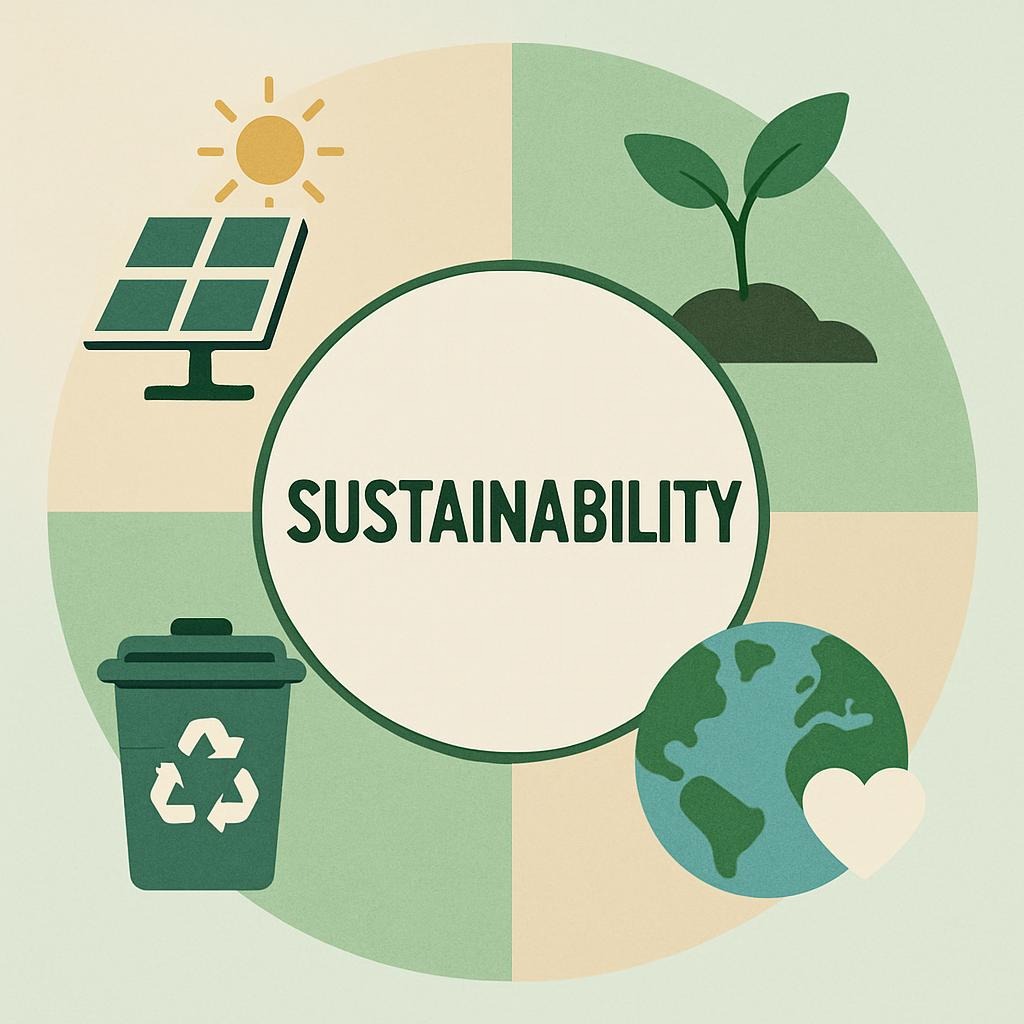
An AI-generated image showing some areas of sustainability
Global policy and economics answers with sources
International treaties regulating greenhouse gas emissions
Direct answer: Treaties should set binding national targets, transparent reporting, carbon market rules, and just-transition finance; enforcement can pair treaty compliance reviews with domestic laws, trade measures, and climate clubs that apply border adjustments for non-compliance.
Direct answer: Align around universal policy goals (design out waste, keep materials in use, regenerate nature), build enabling institutions and standards (ISO circular economy norms), and invest to make recycled feedstocks cheaper and more reliable than virgin inputs.
Policy levers to incentivize renewable energy investment
Direct answer: Use long-term targets, auctions, tax credits, contracts for difference, grid access reforms, public finance de-risking, and carbon pricing to lower cost of capital and crowd-in private investment.
Keywords: auctions, CfDs, tax credits, de-risking, green finance, cost of capital, carbon pricing
Global supply chains and sustainable sourcing
Direct answer: Long, complex supply chains drive emissions, habitat loss, and pollution; effective alternatives include deforestation-free sourcing, verified standards, trade agreements with environmental provisions, and transparency tools across value chains.
Ethical and practical justification for carbon pricing and revenue use
Direct answer: Carbon pricing internalizes externalities and efficiently reduces emissions; revenues (now >$100B globally) should fund clean energy, adaptation, dividends for equity, and industrial decarbonization to balance inflationary and competitiveness effects.
Technology vs. societal change in solving climate crisis
Direct answer: Innovation is essential but insufficient; IPCC finds tech works best with enabling policies and behavioral shifts—demand-side changes, governance, and equity are necessary alongside solar, storage, and AI-enabled resilience.
Headline: Technology must be paired with policy and behavior change to meet climate goals.
Keywords: innovation, demand-side, governance, equity, adaptation, AI
Climate finance for developing countries and success metrics
Direct answer: Developed nations should scale grants and concessional finance toward the new collective quantified goal ($300B/year by 2035, mobilizing $1.3T), prioritize adaptation, and measure success by volume, grant share, country access, and impact.
Direct answer: Major hurdles are fragmented frameworks (GRI/SASB), data quality, assurance, and regulatory divergence (EU CSRD vs others); convergence via interoperable standards and robust data systems is the path forward.
Headline: Interoperable standards, assured data, and regulatory alignment will standardize ESG.
Keywords: CSRD, SEC, GRI, SASB, assurance, data quality, interoperability
Reforming economic models to value natural capital
Direct answer: Embed natural capital into public and private decision‑making via wealth accounting, ecosystem service valuation, and beyond‑GDP metrics; requires better data, market mechanisms, and policy incentives.
Climate action trade-offs with energy security and stability
Direct answer: Diversifying into renewables, nuclear, and efficiency improves both climate and energy security, but transitional policies must manage affordability, reliability, and sectoral impacts (e.g., BECCS land trade-offs).
Environmental and ecological systems answers with sources
Mitigating ocean acidification and restoring coral reefs
Direct answer: Cut CO₂ emissions, reduce nutrient runoff, expand well‑managed MPAs, restore reefs with assisted evolution and local stressor control; seawater alkalinity enhancement is experimental and site‑specific.
Keywords: MPAs, nutrient runoff, alkalinity, coral restoration, local stressors
Scaling regenerative agriculture
Direct answer: Standardize practices and measurement, mobilize finance and supply‑chain demand, build farmer support networks, and integrate into national food strategies to improve yields, soil carbon, and resilience.
Headline: Standards, finance, and market pull can scale regenerative agriculture for food security.
Keywords: soil health, carbon sequestration, measurement, finance, farmer support
Halting and reversing biodiversity loss
Direct answer: Combine protected areas, restoration, sustainable production/consumption, and equity measures under CBD frameworks like the Global Species Action Plan and 30×30 targets.
Headline: Protect, restore, and transform food systems under CBD to bend the biodiversity curve.
Keywords: 30×30, restoration, sustainable consumption, species action plans
Freshwater depletion and conservation innovations
Direct answer: Depletion fuels instability through food, health, and cross‑border tensions; solutions include wastewater reuse, smart metering, aquifer recharge, wetland restoration, and stronger governance of degraded ecosystems.
Microplastic pollution consequences and elimination strategy
Direct answer: Microplastics harm ecosystems and health via pervasive pathways; the viable global strategy is a full plastics value-chain approach: upstream bans, design for durability, extended producer responsibility, and scaled capture and recycling.
Headline: Eliminate microplastics via upstream bans, EPR, better design, and scaled capture/recycling.
Keywords: microplastics, EPR, product design, bans, health impacts, recycling
Urban planning for resilient, sustainable cities
Direct answer: Integrate nature‑based solutions, green/blue infrastructure, low‑carbon mobility, circular waste systems, and multi‑level governance with climate risk data to cut emissions and boost resilience.
Direct answer: Raise formal collection to at least ~38% globally, expand repair/reuse, recover metals, and scale infrastructure and financing to cut net costs and contamination, following Global E‑Waste Monitor targets.
Carbon capture and storage (CCS) potential and concerns
Direct answer: CCS is crucial for hard‑to‑abate sectors but current capacity (~55 Mt/year) is far below needs; concerns include cost, permanence, leakage risks, and potential fossil lock‑in, requiring strict standards and limited use.
SDGs pursued with social equity and environmental justice
Direct answer: Integrate EJ into SDG implementation via disaggregated metrics, rights‑based approaches, and inclusive governance to avoid trade‑offs that harm vulnerable groups.
Headline: Embed environmental justice and disaggregated metrics to deliver equitable SDGs.
Keywords: EJ, disaggregation, inclusion, rights‑based, vulnerable groups
Education’s role and starting age for literacy
Direct answer: Education for Sustainable Development should begin in early childhood and continue lifelong, building cognitive, socio‑emotional, and practical skills that change behaviors and empower action.
Headline: Start ESD early and sustain it—knowledge and values drive lasting behavioral change.
Keywords: ESD, early childhood, socio‑emotional, behavioral change, lifelong learning
Integrating sustainability into public health initiatives
Direct answer: Green healthcare systems (energy, waste, food), design durable interventions with stakeholder co‑creation and financing, and address environmental determinants of disease.
Gender disparities in climate impacts and leadership
Direct answer: Women face disproportionate climate risks yet are underrepresented in governance; gender‑responsive policies, finance, and equal participation improve outcomes and justice.
Encouraging sustainable lifestyles in high‑consumption nations
Direct answer: Combine norms and education (LiFE/ESD), fiscal incentives, product standards, and infrastructure for low‑carbon choices—measuring high‑impact sectors and equity impacts.
Direct answer: Respect FPIC, legal protections, and co‑management to integrate Indigenous knowledge into climate, biodiversity, and land policies—improving resilience and stewardship.
Keywords: FPIC, co‑management, resilience, traditional knowledge, rights
Ensuring a just transition for fossil fuel workers
Direct answer: Invest in regional job creation, retraining aligned to local green industries, wage insurance, and mobility support; plan nationally and coordinate so green jobs appear where workers live.
Headline: Place‑based training and job creation ensure fossil‑fuel workers aren’t left behind.
Keywords: just transition, retraining, wage insurance, geography, local industry
Consumer vs corporate responsibilities
Direct answer: Corporations hold primary responsibility to redesign products, disclose impacts, and meet standards; consumers influence through choices and advocacy but need systemic corporate action and policy.
Accessibility and affordability of sustainable solutions
Direct answer: Scale climate‑resilient affordable housing, targeted subsidies, inclusive finance, and public infrastructure so low‑income households benefit from lower bills and healthier environments.
Headline: Invest in resilient affordable housing and inclusive finance to cut costs and emissions.
Keywords: affordable housing, subsidies, inclusive finance, resilience, health
Measuring and communicating SDG progress
Direct answer: Use official SDG indicators with robust statistics, disaggregation, and linkage analyses; communicate via dashboards and narrative that show interdependencies and equity impacts.