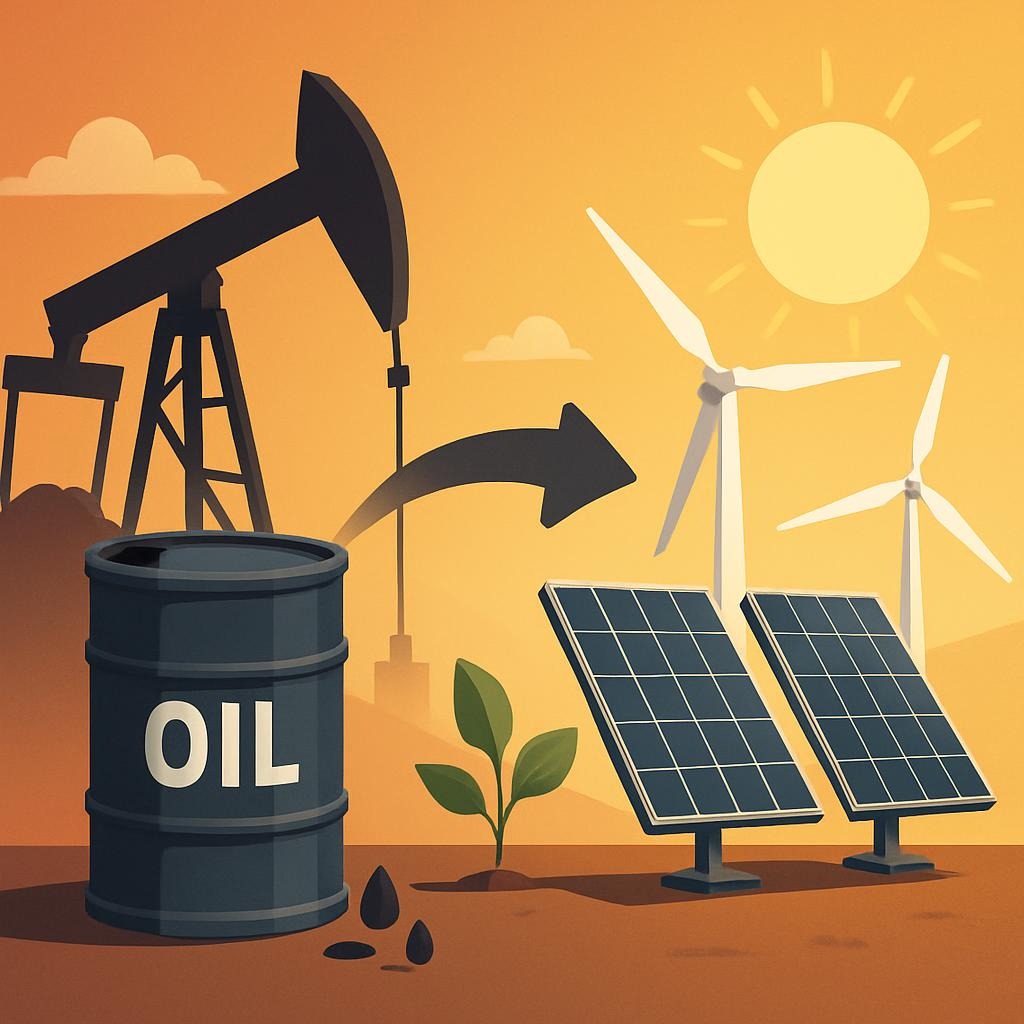
Peak oil by 2030 and the race for post‑hydrocarbon power
I. The future of oil & geopolitics
- Peak oil demand & market reaction
Most mainstream scenarios now see global oil demand peaking before 2030, with the IEA’s latest outlook showing demand flattening this decade and its Oil 2023 report projecting a demand peak around 2028 at ~105–106 mb/d, after which growth slows sharply as EVs and efficiency bite; markets are likely to see structurally lower long‑term price expectations, more volatility around OPEC+ decisions, and accelerated capital flight from high‑cost projects.
Source: IEA World Energy Outlook 2023 –https://www.iea.org/reports/world-energy-outlook-2023(iea.org in Bing) ; IER summary of IEA Oil 2023 – https://www.instituteforenergyresearch.org/international-issues/iea-forecasts-global-oil-demand-peaking-by-2028/ - GCC diversification before revenue decline
GCC economies can diversify successfully only by using the current windfall to accelerate investment into non‑oil sectors (logistics, tourism, advanced manufacturing, green hydrogen, and critical‑minerals processing) while gradually reducing fiscal dependence on crude, a path consistent with IEA and OPEC long‑term scenarios that show oil demand plateauing and then declining but still significant through 2050, giving a narrowing window for transformation.
Source: OPEC World Oil Outlook 2050 – https://www.opec.org/assets/assetdb/woo-2024.pdf ; IEA World Energy Outlook 2023 –https://www.iea.org/reports/world-energy-outlook-2023(iea.org in Bing) - Future influence of OPEC+
As global oil demand peaks and non‑OPEC supply (especially US shale) matures, OPEC+ will likely retain price‑setting power in a shrinking market, but its relative geopolitical leverage declines as oil’s share in the energy mix falls; recent strategy shifts from deep cuts to regaining market share already show the group adapting defensively to preserve influence in a decarbonizing world.
Source: OPEC+ policies and effects – https://www.unitedpetrogroup.com/energyworldnew/1741787406_document.pdf ; GEP on OPEC+ long‑term influence – https://www.gep.com/blog/mind/opec-plus-long-term-market-influence-strategy - Fate of stranded assets
Analyses suggest over USD 1 trillion in oil and gas assets could become stranded under stronger climate policy, with broader estimates of fossil‑fuel asset stranding risk reaching USD ~2.3 trillion by 2040, implying write‑downs, sovereign‑risk stress for petrostates, and pressure on investors to reallocate capital toward low‑carbon assets.
Source: Carbon Tracker “Unburnable Carbon: Ten Years On” – https://carbontracker.org/reports/unburnable-carbon-ten-years-on/ ; OilPrice on stranded assets – https://oilprice.com/Latest-Energy-News/World-News/Stranded-Oil-and-Gas-Assets-Could-Reach-23-Trillion-by-2040.html ; MIT on stranded assets – https://news.mit.edu/2022/stranded-assets-could-exact-steep-costs-fossil-energy-producers-investors-0819 - Geopolitics of critical minerals vs oil
As energy systems electrify, power shifts toward countries controlling lithium, cobalt, nickel, copper and rare earths, with demand for these minerals projected to increase up to 4–6× by 2030–2050, making regions like the African copper–cobalt belt and the South American “lithium triangle” central to new supply‑chain geopolitics and prompting G7‑led efforts to reduce dependence on China‑dominated processing.
Source: IRENA “Geopolitics of the Energy Transition: Critical Materials” – https://www.irena.org/-/media/Files/IRENA/Agency/Publication/2023/Jul/IRENA_Geopolitics_energy_transition_critical_materials_2023.pdf ; IEA commentary on critical minerals security – https://www.iea.org/commentaries/growing-geopolitical-tensions-underscore-the-need-for-stronger-action-on-critical-minerals-security ; UNEP on critical energy transition minerals – https://www.unep.org/topics/energy/renewable-energy/critical-energy-transition-minerals - Oil companies: energy majors or carbon‑capture specialists?
Most large oil companies are evolving into broader “energy companies” with growing portfolios in renewables, biofuels, EV charging and hydrogen, while also betting on CCS to preserve parts of their hydrocarbon business; IEA scenarios show CCS playing a role but not large enough to justify business‑as‑usual upstream expansion, implying that firms that diversify fastest into low‑carbon power and molecules will be more resilient than those relying mainly on carbon capture.
Source: IEA World Energy Outlook 2023 –https://www.iea.org/reports/world-energy-outlook-2023(iea.org in Bing)
II. Renewable energy & technological breakthroughs
- Can the grid keep up with solar and wind?
Studies on integrating variable renewables show that with grid reinforcement, storage, demand‑response, and smarter system operation, high shares of wind and solar (50–80%+ of annual generation) are technically manageable, but require accelerated investment in transmission, flexible generation, and digital control systems to avoid congestion and instability.
Source: “Impact of Integrating Variable Renewable Energy Sources into Grid‑Connected Power Systems” – https://www.mdpi.com/1996-1073/18/3/689 ; IJRES “Challenges and Solutions in Grid Integration of Renewable Energy Sources” – https://www.ijres.org/papers/Volume-13/Issue-7/13075259.pdf - Battery density for long‑haul trucks and aviation
Current commercial Li‑ion packs for EVs are in the few hundred Wh/kg range, and projections for advanced chemistries (solid‑state, lithium‑metal) suggest roughly 2× improvements in specific energy over the next couple of decades, enough to make heavy trucks increasingly viable but still challenging for large, long‑haul aircraft, where hybrid or niche electric aviation is more realistic in the near term.
Source: NASA battery performance projections – https://ntrs.nasa.gov/api/citations/20220005588/downloads/Final%20Paper%20-%20Battery%20Key%20Performance%20Projections%20based%20on%20Historical%20Trends%20and%20Chemistries.pdf ; IEA Global EV Outlook 2025 (battery demand) – https://www.iea.org/reports/global-ev-outlook-2025/electric-vehicle-batteries - Green hydrogen vs natural gas in steel
Analyses of hydrogen‑based direct‑reduced iron show that green hydrogen steel can already be cost‑competitive with natural‑gas‑based routes at gas prices around €15/GJ and CO₂ prices near €100/t, and falling renewable‑power costs plus carbon pricing are expected to push green hydrogen toward parity in key markets in the 2030s.
Source: European Parliament briefing on hydrogen for steel – https://www.europarl.europa.eu/RegData/etudes/BRIE/2020/641552/EPRS_BRI%282020%29641552_EN.pdf ; McKinsey “Getting to greener steel” – https://www.mckinsey.com/featured-insights/week-in-charts/getting-to-greener-steel - Role of nuclear fusion after mid‑century
Fusion is moving from pure research to early commercialization efforts, but even optimistic assessments see first grid‑connected fusion plants only around mid‑century, with fusion complementing rather than displacing renewables by providing firm, low‑carbon power; most reviews stress that wind, solar, fission, and storage must carry decarbonization through 2050 regardless of fusion’s eventual success.
Source: IAEA “Fusion Energy in 2025: Six Global Trends to Watch” – https://www.iaea.org/newscenter/news/fusion-energy-in-2025-six-global-trends-to-watch ; Imperial College “Fusion before 2050?” – https://www.imperial.ac.uk/grantham/publications/briefing-papers/fusion-before-2050-a-net-zero-future-powered-by-fusion-new-possibilities-for-realising-nuclear-fusion-before-2050.php - Perovskites and solar efficiency
Perovskite and perovskite‑silicon tandem cells have already surpassed 30% lab efficiency, and multi‑terawatt PV roadmaps foresee commercial module efficiencies exceeding 35% by 2050, with ongoing work focused on stability and defect passivation to make these gains durable in real‑world conditions.
Source: PV‑Magazine on >35% module efficiency by 2050 – https://www.pv-magazine.com/2026/01/12/solar-module-efficiency-could-exceed-35-by-2050/ ; Nature news on perovskite tandems >30% – https://www.nature.com/articles/d41586-025-03806-x - Recycling solar panels and wind blades
Recent research and pilot projects show that high‑value recycling of silicon PV (glass, aluminum, silver, silicon) is technically feasible and increasingly economical as volumes grow, while wind‑blade recycling is shifting from landfilling to processes like pyrolysis and cement co‑processing; scaling these methods and designing for recyclability are key to making renewables’ end‑of‑life impacts manageable.
Source: Same multi‑terawatt PV perspectives and perovskite reviews (recycling and lifecycle sections) – https://www.pv-magazine.com/2026/01/12/solar-module-efficiency-could-exceed-35-by-2050/ ; https://www.journalijar.com/uploads/2025/11/6933f36dce64b_IJAR-55004.pdf
III. Transportation & infrastructure
- EV TCO parity without subsidies
TCO analyses indicate that battery‑electric vehicles reach or have already reached cost parity with ICEs in many segments by mid‑2020s, driven by lower fuel and maintenance costs; McKinsey projects BEVs outperforming ICEs across all vehicle classes on TCO as early as 2025, even before subsidies, in markets with high fuel prices and dense charging networks.
Source: McKinsey on fleet electrification economics – https://www.mckinsey.com/industries/automotive-and-assembly/our-insights/why-the-economics-of-electrification-make-this-decarbonization-transition-different ; IEA EV TCO tool – https://www.iea.org/data-and-statistics/data-tools/electric-vehicles-total-cost-of-ownership-tool - Biofuels and e‑fuels: saviors or niches?
Because of limited sustainable biomass and the high cost of synthetic e‑fuels, most scenarios see them as niche, high‑value solutions for sectors that are hard to electrify—especially aviation and some shipping—rather than a way to preserve mass‑market combustion cars, where direct electrification is far more efficient and cheaper on a TCO basis.
Source: IEA World Energy Outlook 2023 –https://www.iea.org/reports/world-energy-outlook-2023(iea.org in Bing) ; McKinsey on electrification economics – https://www.mckinsey.com/industries/automotive-and-assembly/our-insights/why-the-economics-of-electrification-make-this-decarbonization-transition-different - Shipping’s transition to ammonia or hydrogen
Decarbonization pathways for maritime transport point to green ammonia and, to a lesser extent, hydrogen and methanol as leading options, but they require new engine technologies, bunkering infrastructure, and large‑scale green‑fuel production; alignment of fuel standards and carbon pricing on shipping routes will determine how fast the sector moves away from heavy fuel oil.
Source: IEA World Energy Outlook 2023 (shipping scenarios) –https://www.iea.org/reports/world-energy-outlook-2023(iea.org in Bing) ; MDPI review on integrating variable renewables (hydrogen/ammonia as flexibility options) – https://www.mdpi.com/1996-1073/18/3/689 - Infrastructure for a hydrogen + electric economy
A dual system requires massive build‑out of renewables, dedicated hydrogen pipelines or repurposed gas networks, storage caverns, port export/import terminals, and industrial clusters using hydrogen, alongside dense EV charging and reinforced grids; planning must avoid stranded hydrogen infrastructure by focusing on sectors where molecules beat electrons (steel, chemicals, shipping).
Source: IEA World Energy Outlook 2023 –https://www.iea.org/reports/world-energy-outlook-2023(iea.org in Bing) ; European Parliament hydrogen–steel briefing – https://www.europarl.europa.eu/RegData/etudes/BRIE/2020/641552/EPRS_BRI%282020%29641552_EN.pdf - Urban design beyond car‑centric models
Compact, transit‑oriented development, cycling infrastructure, and digital mobility services can significantly reduce car ownership and vehicle‑kilometers traveled, cutting energy demand regardless of drivetrain; energy‑transition scenarios that combine electrification with modal shift show the largest reductions in oil demand and urban pollution.
Source: IEA World Energy Outlook 2023 (transport demand and modal shift) –https://www.iea.org/reports/world-energy-outlook-2023(iea.org in Bing)
IV. Environmental & economic impact
- Can CCS scale enough for limited oil use in net‑zero?
Net‑zero pathways give CCS a supporting but not dominant role: capturing several gigatonnes of CO₂ annually by mid‑century, mainly in industry and some power, while overall fossil‑fuel use falls sharply; relying on CCS to preserve high oil consumption would overshoot carbon budgets, so continued but limited oil use is compatible with net‑zero only if paired with aggressive CCS plus rapid demand reduction.
Source: IEA World Energy Outlook 2023 –https://www.iea.org/reports/world-energy-outlook-2023(iea.org in Bing) ; IPCC pathways and stranded‑asset warning – https://www.spglobal.com/sustainable1/en/insights/ipcc-report-outlines-decarbonization-pathways-warns-of-stranded-assets - Just transition for oil and gas workers
A “just transition” requires active labor‑market policies—reskilling into renewables, grids, CCS, decommissioning, and critical‑minerals sectors—plus regional development funds and social protection to avoid abrupt community decline; IPCC and IEA stress that climate policies must be paired with investment in new industries in fossil‑dependent regions to maintain political support.
Source: IPCC pathways and transition risks – https://www.spglobal.com/sustainable1/en/insights/ipcc-report-outlines-decarbonization-pathways-warns-of-stranded-assets ; IEA World Energy Outlook 2023 –https://www.iea.org/reports/world-energy-outlook-2023(iea.org in Bing) - Environmental footprint of “clean” minerals vs oil
Mining for transition minerals can cause land disturbance, water use, and pollution, but lifecycle analyses show that even with expanded mining, total environmental impacts per unit of energy delivered are lower than continued fossil‑fuel extraction and combustion, provided strong environmental and social standards are enforced in mining regions.
Source: IRENA “Geopolitics of the Energy Transition: Critical Materials” – https://www.irena.org/-/media/Files/IRENA/Agency/Publication/2023/Jul/IRENA_Geopolitics_energy_transition_critical_materials_2023.pdf ; WEF “Are Critical Minerals the New Oil?” – https://www3.weforum.org/docs/WEF_Energy_Transition_and_Geopolitics_2024.pdf ; UNEP on critical minerals – https://www.unep.org/topics/energy/renewable-energy/critical-energy-transition-minerals - Global carbon taxes and oil‑product prices
While a single global carbon tax is unlikely soon, more jurisdictions are adopting carbon pricing or border‑adjustment mechanisms; higher effective carbon prices would raise costs for oil‑derived products (fuels, plastics) and improve the competitiveness of low‑carbon alternatives and recycling, accelerating demand destruction for virgin petrochemicals.
Source: IEA World Energy Outlook 2023 –https://www.iea.org/reports/world-energy-outlook-2023(iea.org in Bing) ; McKinsey greener‑steel analysis (CO₂ price sensitivity) – https://www.mckinsey.com/featured-insights/week-in-charts/getting-to-greener-steel - Decommissioning offshore oil rigs
Decommissioning thousands of offshore platforms will cost hundreds of billions of dollars globally, typically funded by operators under regulatory obligations, sometimes supported by tax relief; options include full removal, partial removal with “rigs‑to‑reefs” programs, and repurposing for offshore wind or CCS hubs, all of which require clear liability frameworks to avoid stranded environmental risks.
Source: MIT stranded‑assets study – https://news.mit.edu/2022/stranded-assets-could-exact-steep-costs-fossil-energy-producers-investors-0819 ; IEA World Energy Outlook 2023 –https://www.iea.org/reports/world-energy-outlook-2023(iea.org in Bing)
V. The role of natural gas & alternatives
- Is natural gas really a bridge fuel?
Gas emits about 50–60% less CO₂ per kWh than coal when burned, but methane leakage along the value chain can erode this advantage; IPCC‑aligned analyses conclude gas can act as a short‑term bridge only if leakage is tightly controlled and if its use declines after the 2030s in favor of renewables and low‑carbon flexibility options.
Source: IPCC pathways and fossil‑fuel risks – https://www.spglobal.com/sustainable1/en/insights/ipcc-report-outlines-decarbonization-pathways-warns-of-stranded-assets ; IEA World Energy Outlook 2023 –https://www.iea.org/reports/world-energy-outlook-2023(iea.org in Bing) - SMRs and nuclear perception
Small modular reactors promise lower upfront costs, standardized designs, and enhanced passive safety, which could improve public acceptance if early projects demonstrate reliability and cost control; reviews of future energy supply see SMRs as potentially important for decarbonizing grids and industrial heat in some countries, but not a universal solution given regulatory, waste, and cost challenges.
Source: “Fusion energy: a sustainable pathway…” (broader nuclear context) – https://link.springer.com/article/10.1007/s43621-025-00906-6 ; “Role of Nuclear Fusion in Future Energy Supply” (comparative nuclear discussion) – https://www.allmultidisciplinaryjournal.com/uploads/archives/20250630130136_MGE-2025-3-377.1%20.pdf - Scaling geothermal with oil‑industry drilling
Enhanced geothermal systems can leverage advanced drilling, reservoir characterization, and well‑completion techniques developed in oil and gas, potentially unlocking geothermal resources in many regions; global assessments see geothermal as a modest but reliable contributor to baseload power and heat if costs fall through technology transfer and learning curves.
Source: IEA World Energy Outlook 2023 –https://www.iea.org/reports/world-energy-outlook-2023(iea.org in Bing) ; MDPI review on integrating renewables and flexibility options – https://www.mdpi.com/1996-1073/18/3/689 - Tidal and wave energy for baseload
Tidal and wave resources are predictable and can provide firm, low‑carbon power for coastal grids, but high capital costs, harsh marine environments, and limited suitable sites mean they are likely to remain regional supplements rather than global backbone technologies, unless major cost breakthroughs occur.
Source: IEA World Energy Outlook 2023 (ocean energy sections) –https://www.iea.org/reports/world-energy-outlook-2023(iea.org in Bing)
VI. Consumer behavior & policy
- Smart homes, microgrids, and reduced oil reliance
Smart homes with rooftop PV, batteries, and demand‑response, combined with community microgrids, reduce dependence on centralized fossil‑fired generation by shifting consumption to local renewables and flattening peaks; as electrification spreads, this primarily displaces gas and oil in heating and power, shrinking the role of oil‑fired utilities to niche backup in many regions.
Source: IEA World Energy Outlook 2023 –https://www.iea.org/reports/world-energy-outlook-2023(iea.org in Bing) ; NumberAnalytics “Renewable Energy Grid Integration: Challenges and Solutions” – https://www.numberanalytics.com/blog/renewable-energy-grid-integration-challenges-solutions - Paris Agreement and national energy policy
The Paris Agreement’s “ratchet” mechanism and transparency framework have pushed many countries to adopt net‑zero targets and revise energy policies, but domestic politics and economics still dominate; WEO 2023 shows a gap between current policies and Paris‑aligned pathways, implying that while Paris shapes direction and ambition, it does not rigidly dictate national energy mixes.
Source: IEA World Energy Outlook 2023 –https://www.iea.org/reports/world-energy-outlook-2023(iea.org in Bing) - Right to repair, circular economy, and plastics demand
Right‑to‑repair rules and circular‑economy strategies (reuse, refill, high‑quality recycling) can significantly reduce demand for virgin oil‑based plastics, especially in packaging and consumer goods, but petrochemical demand still grows in many scenarios unless accompanied by strong regulation, design standards, and carbon pricing on primary plastics.
Source: IEA World Energy Outlook 2023 –https://www.iea.org/reports/world-energy-outlook-2023(iea.org in Bing) ; UNEP on critical minerals and materials demand – https://www.unep.org/topics/energy/renewable-energy/critical-energy-transition-minerals - Energy poverty and skipping the oil age
Decentralized renewables (mini‑grids, solar home systems) already provide first‑time electricity access in many developing regions, allowing them to leapfrog centralized oil‑based power; however, addressing energy poverty at scale still requires concessional finance, grid expansion, and policies ensuring that clean technologies are affordable, or poorer countries risk being locked into outdated fossil infrastructure.
Source: IEA World Energy Outlook 2023 (energy access) –https://www.iea.org/reports/world-energy-outlook-2023(iea.org in Bing) ; UNEP on clean‑energy minerals and access – https://www.unep.org/topics/energy/renewable-energy/critical-energy-transition-minerals
Keywords
Keywords: peak oil demand, OPEC+, stranded assets, critical minerals geopolitics, green hydrogen, battery energy density, perovskite solar cells, nuclear fusion, CCS, just transition, EV TCO parity, biofuels, synthetic e‑fuels, ammonia shipping, hydrogen economy, smart grids, Paris Agreement, carbon pricing, natural gas bridge fuel, SMRs, geothermal energy, tidal power, circular economy, energy poverty, global energy transition.
About the Author