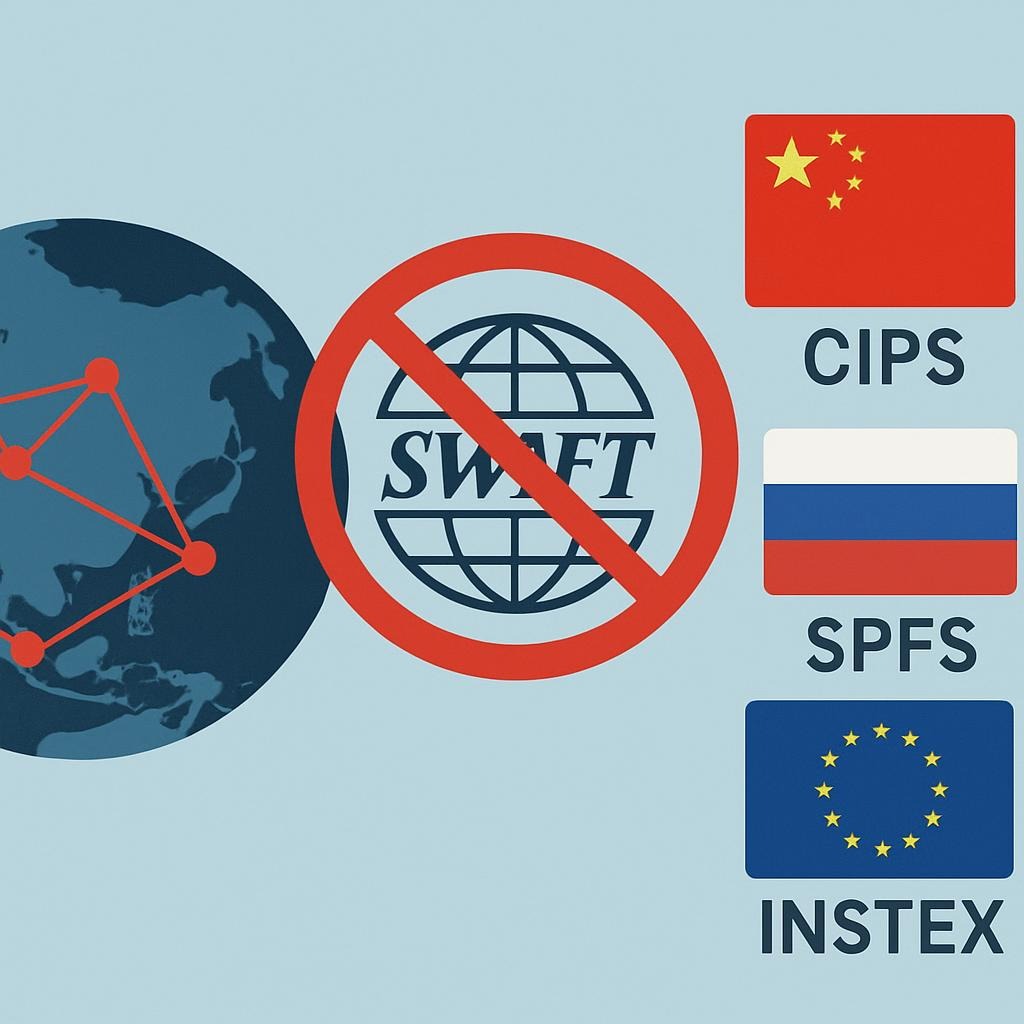
1. CIPS as a clearing house: How is it different from SWIFT?
China’s CIPS is an onshore infrastructure that provides both clearing and settlement in RMB, whereas SWIFT is only a messaging network that instructs payments which are then settled via separate correspondent and RTGS systems. CIPS allows participating banks to hold and settle RMB positions directly within the system in real time, reducing reliance on offshore RMB correspondent banks and shortening the chain of intermediaries.
Source: https://statrys.com/blog/what-is-cips-china (statrys.com in Bing)
Keywords: CIPS, clearing and settlement, SWIFT messaging, RMB internationalization, correspondent banking
2. How far has Russia’s SPFS mitigated the 2022–2025 “de‑platforming”?
SPFS, created by the Russian central bank in 2014 to reduce sanctions exposure, has provided a domestic and regional fallback for interbank messaging after Russian banks were cut from SWIFT. It has helped keep Russia’s internal payments functional and enabled limited cross‑border links with some Eurasian partners, but Western sanctions pressure and OFAC warnings have discouraged many foreign banks from joining, keeping SPFS far from a full SWIFT substitute.
Source: https://ofac.treasury.gov/media/933656/download?inline (ofac.treasury.gov in Bing)
Keywords: SPFS, Russian sanctions, SWIFT cutoff, de‑platforming, alternative messaging
3. mBridge’s multi‑CBDC design: Why no need for US correspondent banks?
Project mBridge is a multi‑CBDC platform where participating central banks issue wholesale CBDCs onto a shared DLT ledger, enabling commercial banks to transact peer‑to‑peer in central bank money across borders. Because FX and settlement occur directly between CBDC balances on the common ledger, value moves without going through dollar‑based correspondent accounts in New York, effectively eliminating the traditional US correspondent bank layer for participating corridors.
Source: https://www.bis.org/innovation_hub/projects/mbridge_brochure_2311.pdf (bis.org in Bing)
Keywords: mBridge, multi‑CBDC, DLT, correspondent banking, cross‑border settlement
4. UPI with PayNow and AANI: How is a non‑SWIFT retail corridor built?
The UPI–PayNow linkage connects India’s UPI and Singapore’s PayNow so users in both countries can send retail payments in real time using just a mobile number or UPI ID, with settlement handled via linked national instant‑payment infrastructures rather than SWIFT wires. A similar model underpins India’s UPI connection with the UAE’s AANI, using API‑level integration between real‑time domestic systems to route retail transactions outside the correspondent‑bank/SWIFT stack.
Source: https://apacnewsnetwork.com/2025/07/india-singapore-upi-paynow-cross-border-payment-system-goes-fully-live (apacnewsnetwork.com in Bing)
Keywords: UPI, PayNow, AANI, instant payments, non‑SWIFT retail corridor
5. Why INSTEX failed and what it taught future SPVs
INSTEX, designed as an SPV to facilitate non‑USD, non‑SWIFT trade with Iran, executed only one transaction and was liquidated in 2023. It failed due to intense US secondary‑sanctions pressure on European firms, very narrow humanitarian scope, and Iranian non‑cooperation/obstruction, showing that technical workarounds are useless without political alignment, real commercial incentives, and legal shielding for participants.
Source: https://www.foreignaffairsreview.com/home/the-instex-project-why-did-europes-ambitious-financial-vehicle-fail-and-what-next (foreignaffairsreview.com in Bing)
Keywords: INSTEX, special purpose vehicle, Iran trade, sanctions, European autonomy
6. How CBDCs bypass SWIFT’s messaging/settlement delays
CBDC platforms combine message + value transfer: updating tokenized central bank liabilities on a shared ledger settles the payment instantly once validated, instead of sending MT/MX messages that then wait for correspondent and RTGS cycles. In cross‑border CBDC designs, fewer intermediaries and direct ledger updates reduce settlement risk, pre‑funding needs, and the multi‑day T+1/T+2 delays typical of correspondent‑bank chains.
Source: https://www.elibrary.imf.org/downloadpdf/view/journals/063/2024/002/article-A001-en.pdf (elibrary.imf.org in Bing)
Keywords: CBDC, instant settlement, correspondent banking, cross‑border payments, SWIFT delays
7. Internal ledgers of fintechs (Revolut, Wise) as quasi‑alternative rails
Fintechs like Revolut maintain internal multi‑currency ledgers so that transfers between their customers clear instantly inside their own books, with no SWIFT message needed unless money enters or leaves the platform’s external bank accounts. By netting flows and using cheaper local payout rails or even blockchain rails for external settlement, they minimize use of the traditional interbank network while presenting the user a single, seamless interface.
Source: https://moverdb.com/international-money-transfer-services/revolut-review (moverdb.com in Bing)
Keywords: Revolut, Wise, internal ledger, off‑SWIFT transfers, neo‑banks
8. Can BRICS Pay unify disparate national systems?
BRICS Pay is conceived as a decentralized payment messaging and digital platform that lets members settle in their own currencies and interconnect domestic systems under a BRICS‑run governance, rather than Western infrastructure. In principle it could offer a unified interface over heterogeneous national rails, but actual unification depends on common technical standards, FX arrangements, and political trust among members; so far, it is more an emerging framework than a fully integrated live network.
Source: https://cointelegraph.com/explained/what-is-brics-pay-and-why-does-it-matter (cointelegraph.com in Bing)
Keywords: BRICS Pay, multipolar finance, payment messaging, de‑dollarization, interoperability
Effectiveness and technical performance
9. mBridge speed vs SWIFT’s T+1/T+2 settlement
mBridge trials show cross‑border payments and FX can be completed in near real‑time (on the order of seconds), with the BIS and HKMA noting settlement shifting from multiple days to almost real‑time on the mBridge Ledger. Traditional cross‑border payments over SWIFT messages typically settle on T+1 or T+2, because actual funds move through correspondent and RTGS systems that batch and reconcile, so mBridge is roughly “minutes vs days” rather than T+2’s 48‑hour standard.
Source: https://www.hkma.gov.hk/media/eng/doc/key-functions/financial-infrastructure/mBridge_Building_a_multi_CBDC_platform_for_international_payments.pdf (hkma.gov.hk in Bing)
Keywords: transaction speed, mBridge, T+2, cross‑border settlement, real‑time payments
10. The liquidity trap for non‑reserve‑currency alternatives
Most alternatives (CIPS, SPFS, regional CBDC platforms) settle in non‑reserve currencies, so participants must source and hold those currencies, often in shallow FX markets with limited hedging instruments. That creates a “liquidity trap”: even if the rail is technically efficient, large‑value traders still prefer dollar or euro rails where deep, 24/7 FX and collateral markets exist, limiting scale until liquidity in alternative currencies deepens.
Source: https://currencyinsider.com/2024/09/07/push-for-alternatives-to-us-dollar-and-new-payment-systems-accelerates-as-sanctions-scale (currencyinsider.com in Bing)
Keywords: liquidity trap, non‑reserve currency, FX depth, alternative payment systems
11. CIPS transaction costs vs SWIFT wire fees
CIPS reduces costs mainly by shortening correspondent chains and centralizing RMB clearing, which cuts intermediary fees and time‑value costs versus multi‑hop SWIFT wires. Exact fees vary by bank, but corporate reports and analyses note that RMB cross‑border payments via CIPS are typically cheaper than equivalent USD wires, where each correspondent may add handling and FX spreads, whereas CIPS participants can access more direct RMB settlement with fewer layers.
Source: https://statrys.com/blog/what-is-cips-china (statrys.com in Bing)
Keywords: CIPS fees, SWIFT wire costs, intermediary charges, RMB clearing
12. AML/KYC rigor in alternative systems vs SWIFT
SWIFT itself does not perform KYC on end‑customers; compliance is done by participating institutions, and the same is true for CIPS, SPFS, BRICS Pay, and CBDC platforms, which all embed local AML/KYC rules and data‑sharing requirements into their governance frameworks. Systems like mBridge and most CBDC pilots explicitly aim to preserve or enhance AML capabilities by richer structured data and traceability on DLT, but enforcement quality ultimately depends on how strict participating jurisdictions are, not on the rail alone.
Source: https://www.swift.com/news-events/news/iso-20022-new-era-global-payments (swift.com in Bing)
Keywords: AML, KYC, compliance, CBDC, SWIFT alternatives
13. ISO 20022 as the interoperability layer
ISO 20022 has become the global standard language for cross‑border payments, with SWIFT completing migration to ISO for cross‑border traffic in 2025, replacing legacy MT messages. Many alternatives, including CIPS and emerging CBDC systems, also adopt ISO 20022‑style rich data structures, making it easier to interoperate, run analytics, and align compliance screening across different networks.
Source: https://www.swift.com/news-events/news/iso-20022-new-era-global-payments (swift.com in Bing)
Keywords: ISO 20022, payment messaging, interoperability, CIPS, SWIFT migration
14. Security vulnerabilities: decentralized vs SWIFT’s centralized fortress
SWIFT operates a highly centralized but tightly secured core, focusing risk on a small number of critical nodes but enabling heavy investment in perimeter security and monitoring (notwithstanding endpoint fraud incidents). Decentralized or DLT‑based alternatives spread validation across more nodes, improving resilience against a single point of failure but expanding the attack surface: smart‑contract bugs, key management failures, consensus attacks, and heterogeneous node security can all become systemic weaknesses if governance is weak.
Source: https://www.bis.org/publ/othp88_system_design.pdf (bis.org in Bing)
Keywords: cybersecurity, DLT, centralized infrastructure, single point of failure, smart‑contract risk
15. Atomic settlement in CBDCs vs SWIFT’s settlement risk
Atomic settlement means delivery‑versus‑payment (DvP) or payment‑versus‑payment (PvP) occurs in a single, indivisible transaction on the ledger: either both sides execute, or nothing does. This removes the principal risk present in SWIFT‑based flows, where one leg may settle before the other across different systems and time zones; in CBDC experiments like mBridge, FX and payment legs are locked together in the same ledger event, collapsing settlement risk to technical uptime and governance risk.
Source: https://g24.org/wp-content/uploads/2025/04/Using-CBDC-to-transform-global-payments-infrastructure.pdf (g24.org in Bing)
Keywords: atomic settlement, DvP, PvP, settlement risk, CBDC
Geopolitics and sanctions resistance
16. Can moving to CIPS or SPFS really “sanction‑proof” a country?
Migration to CIPS or SPFS may reduce exposure to US‑controlled messaging and dollar rails, but it does not eliminate vulnerability to asset freezes, export controls, or sanctions on counterparties and shipping insurance. Even on CIPS or SPFS, counterpart banks can themselves be sanctioned, and foreign institutions face US pressure and OFAC warnings if they adopt these systems to bypass sanctions, so “sanction‑proofing” is partial at best.
Source: https://ofac.treasury.gov/media/933656/download?inline (ofac.treasury.gov in Bing)
Keywords: sanctions, CIPS, SPFS, de‑platforming, OFAC risk
17. Weaponization of the dollar as catalyst for alternatives
Sweeping sanctions on Russia after 2022—including reserve freezes and SWIFT expulsions—have accelerated de‑dollarization efforts and pushed countries to explore alternative rails like CIPS, CBDCs, and regional payment systems. Studies on BRICS and global fragmentation note that fear of dollar‑based financial coercion is now a core driver of investment in new payment networks and local‑currency trade arrangements.
Source: https://currencyinsider.com/2024/09/07/push-for-alternatives-to-us-dollar-and-new-payment-systems-accelerates-as-sanctions-scale (currencyinsider.com in Bing)
Keywords: weaponization of the dollar, de‑dollarization, Russia sanctions, alternative rails
18. Does RMB in CIPS replace the dollar or just shift dependence?
CIPS is explicitly designed to internationalize the RMB and reduce China’s reliance on Western systems, but participants who route more trade via CIPS effectively increase their dependence on Chinese policy, legal standards, and financial openness. In that sense, CIPS offers a political and technical alternative to dollar rails, but not “neutrality”: it largely swaps exposure to US governance and sanctions risk for exposure to Chinese governance and domestic‑policy risk.
Source: https://vestnik-muiv.ru/upload/iblock/8a7/oq4o9rwq6rl4co0ig231ogaumolav9rw.pdf (vestnik-muiv.ru in Bing)
Keywords: RMB internationalization, dollar dominance, CIPS, financial dependence, China
19. Neutral hubs (Switzerland, Singapore) balancing SWIFT vs rivals
Financial hubs like Switzerland and Singapore remain deeply integrated into SWIFT and Western regulatory frameworks, but they also host innovation sandboxes and links to alternative rails (CBDCs, UPI‑style connections, and regional infrastructures) to preserve neutrality and competitiveness. Their strategy is not to abandon SWIFT but to multi‑home—supporting multiple networks while obeying sanctions and AML rules—to avoid being forced into a binary political choice.
Source: https://apacnewsnetwork.com/2025/07/india-singapore-upi-paynow-cross-border-payment-system-goes-fully-live (apacnewsnetwork.com in Bing)
Keywords: Switzerland, Singapore, financial hub, neutrality, multi‑homing
20. Will alternative systems create global financial fragmentation?
ECB and other analyses warn that geopolitical tensions and sanctions are already driving “geopolitical fragmentation” in international currency use and payment networks, with blocs forming around political alignments. As BRICS‑linked rails, CBDC platforms, and Western‑centric systems evolve in parallel, the risk is a more balkanized payment landscape with reduced network effects, higher cross‑bloc friction, and greater systemic complexity.
Source: https://www.ecb.europa.eu/press/other-publications/ire/article/html/ecb.ireart202306_01~11d437be4d.en.html (ecb.europa.eu in Bing)
Keywords: financial fragmentation, blocs, BRICS, SWIFT, geopolitical risk
21. Stablecoins as a shadow SWIFT for B2B in sanctioned regions
Dollar‑pegged stablecoins such as USDT and USDC already move hundreds of billions in annual volume, and are increasingly used for cross‑border payments and trade, sometimes specifically to bypass banking channels constrained by sanctions or capital controls. Corporates and intermediaries can settle invoices in stablecoins on public blockchains, then cash out locally, creating a parallel, always‑on rail outside SWIFT—though this is drawing growing regulatory scrutiny and on‑/off‑ramp enforcement.
Source: https://chainstack.com/stablecoins-in-cross-border-settlements (chainstack.com in Bing)
Keywords: stablecoins, USDT, USDC, sanctions evasion, cross‑border trade
The future of competition
22. SWIFT’s CBDC Interlinking Platform: Co‑option, not replacement
SWIFT’s CBDC interoperability “connector” is designed to link multiple CBDC and tokenized‑asset networks with existing SWIFT infrastructure, so banks can route CBDC payments through familiar SWIFT interfaces. By positioning itself as the neutral “interlinking layer” for both traditional and digital rails, SWIFT is trying to co‑opt CBDC innovation and prevent fragmentation from sidelining its network.
Source: https://www.swift.com/news-events/press-releases/swift-sets-industry-seamless-introduction-cbdcs-cross-border-transactions-interlinking-solution-finds-more-use-cases (swift.com in Bing)
Keywords: SWIFT CBDC connector, interoperability, tokenized assets, interlinking platform
23. A future dual‑rail world: SWIFT vs CBDC‑based networks?
Current trajectories suggest a hybrid multi‑rail world rather than a neat West/South split: SWIFT is integrating CBDCs, while BRICS and regional blocs are building their own rails. Many banks will likely operate on both SWIFT and CBDC/alternative networks, choosing rails by corridor, counterparty risk, and cost—so the “dual‑rail” divide may track political blocs, but with substantial overlap for global institutions.
Source: https://www.aijbm.com/wp-content/uploads/2025/04/G845978.pdf (aijbm.com in Bing)
Keywords: dual‑rail system, Global South, CBDC networks, SWIFT, multipolar payments
24. If 30% of trade leaves SWIFT, what happens to dollar reserve status?
Academic and policy work on international currencies argues that reserve status rests on network effects, liquidity, and deep safe‑asset markets, not just on which rail transmits messages. If 30% of trade moved to non‑SWIFT rails but still invoiced and settled largely in dollars (including dollar stablecoins), the dollar would remain dominant; a serious hit to reserve status would require both trade invoicing and financial asset demand to swing toward RMB, euro, or other units on those alternative rails.
Source: https://www.ecb.europa.eu/press/other-publications/ire/article/html/ecb.ireart202306_01~11d437be4d.en.html (ecb.europa.eu in Bing)
Keywords: dollar reserve status, trade invoicing, de‑dollarization, alternative rails
25. AI as “translator” hiding friction between systems
AI can ingest ISO 20022 messages, proprietary APIs, and blockchain transaction formats to map and orchestrate flows across multiple rails, dynamically choosing routes, handling compliance checks, and normalizing data for banks and corporates. In practice, this can make a fragmented infrastructure appear unified at the user level, with AI‑driven payment engines abstracting away whether a given transaction runs over SWIFT, CIPS, a CBDC platform, or a stablecoin rail.
Source: https://www.citigroup.com/global/insights/future-cross-border-payments-now-swift-iso-20022-migration (citigroup.com in Bing)
Keywords: AI, payment orchestration, ISO 20022, interoperability, abstraction layer
26. Could a private network from X/Meta compete with SWIFT and states?
Technically yes: Meta’s Libra/Diem showed that a large platform can design a global settlement token and network that bypasses banks, but the backlash demonstrated powerful state resistance to private monetary infrastructures at scale. Any X or Meta‑led network that reached systemic importance would face bank‑like regulation, capital rules, and political pushback, so it could become an important rail for retail/consumer flows, but full SWIFT‑level systemic status is unlikely without tight public oversight.
Source: https://www.fxcintel.com/research/reports/ct-state-of-stablecoins-cross-border-payments-2025 (fxcintel.com in Bing)
Keywords: private payment networks, Big Tech, Libra, Diem, regulatory backlash
27. SWIFT’s future: niche Western system or enduring “gold standard”?
By embracing ISO 20022 and CBDC interlinking, SWIFT is actively evolving rather than standing still, aiming to remain the default neutral backbone for compliant cross‑border payments. Its global reach and embedded role in bank compliance give it strong inertia, but if geopolitical blocs deepen and alternative rails mature, SWIFT could gradually concentrate in high‑value, highly regulated corridors while more routine or politically sensitive flows migrate elsewhere.
Source: https://www.fxcintel.com/research/reports/swift-iso-20022-impact-payments-explained (fxcintel.com in Bing)
Keywords: SWIFT, gold standard, future role, compliance, competition
28. Systemic risk if a major alternative (e.g., CIPS) suffers a cyber‑attack
A successful large‑scale attack on CIPS or a major CBDC platform could disrupt RMB‑denominated trade flows, trigger loss of confidence in that rail, and force emergency re‑routing back to SWIFT/correspondent systems, creating congestion and market stress. Because many alternatives are being built as critical infrastructure for sanction‑sensitive states, such an event would also carry geopolitical escalation risk, prompting calls for stricter global cyber standards and possibly reinforcing preference for more battle‑tested, diversified infrastructures.
Source: https://www.bis.org/publ/othp88_system_design.pdf (bis.org in Bing)
Keywords: cyber‑attack, systemic risk, CIPS, CBDC platforms, financial stability
29. BIS’s balancing act: fostering mBridge while guarding the legacy system
The BIS Innovation Hub presents mBridge as a public good experiment to tackle cross‑border payment frictions and advance settlement in central bank money, but BIS also has a mandate to safeguard monetary and financial stability. Its approach is to prototype architectures (like mBridge), publish design and risk work, then step back and let central banks decide deployment—encouraging innovation while signaling that interoperability, “do no harm,” and prudential oversight must anchor any shift away from traditional systems.
Source: https://www.bis.org/about/bisih/topics/cbdc/mcbdc_bridge.htm (bis.org in Bing)
Keywords: BIS, mBridge, innovation hub, financial stability, public good
30. The single biggest hurdle to fully replacing SWIFT
The hardest obstacle is political and legal, not purely technical: replacing SWIFT would require broad international agreement on governance, sanctions policy, dispute resolution, data access, and liability across rival blocs. No alternative today combines SWIFT’s global reach, perceived neutrality, legal underpinnings, and compliance ecosystem; until there is a widely accepted global rulebook and trust framework for a successor, the world is more likely to add rails than to fully retire SWIFT.
Source: https://www.aijbm.com/wp-content/uploads/2025/04/G845978.pdf (aijbm.com in Bing)
Keywords: legal hurdle, global governance, trust framework, SWIFT replacement, geopolitics
About the Author