I. Historical context & foundations
1. Headline: McMahon Line 1914 – Colonial Tibet–India Boundary That China Rejects as Illegitimate
The McMahon Line was drawn at the 1913–14 Simla Convention between British India and Tibet as the boundary between Tibet and British India, forming the basis of today’s border in Arunachal Pradesh and of the eastern sector of the 1962 war. Wikipedia Britannica China has consistently refused to recognize it because it rejects the Simla Convention (arguing Tibet lacked treaty‑making authority) and views the line as an imperial, unequal, and therefore legally void colonial imposition on Chinese sovereignty over Tibet. Britannica legalclarity.org SPM IAS Academy
Source: https://en.wikipedia.org/wiki/McMahon_Line Wikipedia
Keywords: McMahon Line, Simla Convention 1914, British India, Tibet, Chinese sovereignty, unequal treaties, Arunachal Pradesh dispute
2. Headline: Panchsheel 1954 – Idealistic Principles That Collapsed Under Tibet and Border Reality
The 1954 Sino‑Indian Agreement (Panchsheel) codified five principles—mutual respect for sovereignty, non‑aggression, non‑interference, equality and peaceful coexistence—and was meant to stabilize relations, especially over Tibet. Wikipedia Chegg India Testbook It failed to prevent war because it left the boundary itself unresolved, tensions in Tibet escalated after 1959, and mutual threat perceptions rose while military postures hardened, so the lofty principles had no enforceable mechanism once both sides began treating the frontier as a security problem rather than a diplomatic one. Chegg India Testbook 北海道大学スラブ・ユーラシア研究センター
Source: https://en.wikipedia.org/wiki/1954_Sino-Indian_Agreement Wikipedia
Keywords: Panchsheel, Five Principles, 1954 Sino‑Indian Agreement, Tibet, unresolved border, trust deficit, 1962 war
3. Headline: 1959 Tibetan Uprising and Dalai Lama’s Asylum – Major Political Trigger but Not Sole Cause of 1962
The 1959 Lhasa uprising and the Dalai Lama’s flight to India, where he received asylum and set up a government‑in‑exile, turned Tibet from a shared buffer into a symbol of Chinese sovereignty versus Indian hospitality to Tibetan nationalism. Wikipedia IJCRT MIT Press Declassified analyses show Beijing saw India as shielding a “splittist” leader and interfering in internal affairs, which sharply worsened trust and contributed significantly to the path to war, though structural border disputes and differing frontier maps were already in place before 1959. JSTOR IJCRT MIT Press
Source: https://en.wikipedia.org/wiki/1959_Tibetan_uprising Wikipedia
Keywords: Tibetan uprising 1959, Dalai Lama asylum, Dharamsala, Tibet question, Sino‑Indian distrust, internal affairs, 1962 causes
4. Headline: Nehru’s Forward Policy – Thin Forward Posts That Helped Provoke China’s 1962 Offensive
Nehru’s “Forward Policy” ordered India to establish small “forward” posts in disputed areas, including behind what China saw as its own claim lines, in order to assert Indian sovereignty without major fighting. Wikipedia JSTOR These lightly supplied, exposed posts—especially Dhola Post—were interpreted in Beijing as an encroaching strategy; Chinese leaders cited the policy, along with the Dalai Lama’s presence and alignment with Moscow, as reasons for a punitive offensive in October 1962 to enforce their own claim lines. Wikipedia Oxford Academic Taylor & Francis eBooks, Reference Works and Collections
Source: https://en.wikipedia.org/wiki/Forward_policy_(Sino-Indian_conflict) Wikipedia
Keywords: Forward Policy, Nehru, Dhola Post, punitive war, claim lines, deterrence failure, 1962 escalation
5. Headline: Cuban Missile Crisis – Global Distraction That Enabled China’s Short 1962 War Window
The Sino‑Indian War (20 Oct–21 Nov 1962) unfolded almost exactly alongside the Cuban Missile Crisis (16–28 Oct 1962), when the US and USSR were locked in nuclear confrontation over missiles in Cuba. Wikipedia Wikipedia Scholars argue this timing gave Beijing confidence that both superpowers were too distracted to intervene or materially back India, helping justify a limited, time‑boxed offensive that China ended unilaterally once it had made its political point and secured its positions. Wikipedia Hoover Institution
Source: https://www.hoover.org/research/1962-sino-indian-war-and-cuban-missile-crisis Hoover Institution
Keywords: Cuban Missile Crisis, 1962 Sino‑Indian War timing, superpower distraction, limited war, Mao, Zhou Enlai
6. Headline: Aksai Chin – Critical Corridor Linking Xinjiang to Tibet via G219 Highway
Aksai Chin is strategically vital because it hosts the Xinjiang–Tibet highway (China National Highway G219), which runs along China’s western and southern border and physically connects Xinjiang to Tibet across high plateau terrain. Wikipedia NDTV Control over Aksai Chin allows China secure internal military and logistical movement between two sensitive regions and now underpins plans for a Xinjiang–Tibet rail link, reinforcing its integration of the frontier and raising Indian concerns about rapid PLA reinforcement near Ladakh. Wikipedia NDTV Firstpost
Source: https://en.wikipedia.org/wiki/China_National_Highway_219 Wikipedia
Keywords: Aksai Chin, G219 highway, Xinjiang–Tibet link, PLA logistics, Ladakh, rail corridor, strategic depth
7. Headline: 1962 Defeat – Shock That Drove Massive Indian Defence Buildup and Shift to Deterrence
India’s 1962 defeat led to a sustained rise in defence spending, major army expansion, and a reorientation from idealistic non‑alignment to hard‑nosed military preparedness on the northern front. History with Travel Wikipedia The war spurred institutional reforms—creation and strengthening of border forces, intelligence revamps, and a long‑term modernization effort—that turned the Sino‑Indian frontier into a heavily militarized, deterrence‑oriented theater shaping doctrine to this day. History with Travel DefenceXP – Indian Defence Network polityprober.in
Source: https://en.wikipedia.org/wiki/Sino-Indian_War Wikipedia
Keywords: defence spending, post‑1962 reforms, Indian Army expansion, border militarization, doctrine shift, deterrence
8. Headline: 1967 Nathu La & Cho La – Indian Tactical Victory That Stabilized a De Facto LAC
In 1967, fierce clashes at Nathu La (11–15 September) and Cho La (1 October) between Indian and Chinese forces in Sikkim ended in clear Indian tactical advantage, with higher Chinese casualties and eventual PLA withdrawal from forward positions. Wikipedia grokipedia.com This episode signaled that India would contest incursions robustly, helped cement India’s control over Sikkim (later incorporated into India), and contributed to a more stable, though still disputed, understanding of the de facto Line of Actual Control in that sector. Wikipedia India Today u3anunawading.org.au
Source: https://en.wikipedia.org/wiki/Nathu_La_and_Cho_La_clashes Wikipedia
Keywords: Nathu La 1967, Cho La, Sikkim, Indian victory, PLA setback, LAC consolidation, post‑1962 deterrence
9. Headline: Rajiv Gandhi’s 1988 Beijing Visit – Normalization Pivot That Parked the Border and Opened Trade
Rajiv Gandhi’s December 1988 visit to China—the first by an Indian PM since 1954—“broke the ice,” set up a Joint Working Group on the boundary, and committed both sides to “peace and tranquillity” while expanding trade, cultural, and scientific exchanges. JSTOR Business Standard 中华人民共和国外交部 This effectively de‑linked rapid economic cooperation from an immediate border settlement, inaugurating the post‑1988 phase where the frontier stayed disputed but relatively quiet while bilateral commerce and engagement grew dramatically. JSTOR 中华人民共和国外交部 Hindustan Times
Source: https://www.mfa.gov.cn/eng/zy/wjls/3604_665547/202405/t20240531_11367553.html 中华人民共和国外交部
Keywords: Rajiv Gandhi 1988, Joint Working Group, peace and tranquillity, economic normalization, boundary talks, engagement without settlement
10. Headline: Memory of 1962 – Persistent “Betrayal” Narrative Shaping Indian Views of China
Indian political and academic discourse often frames 1962 through “betrayal narratives”: either China alone is blamed for a sudden, treacherous attack, or both Chinese expansionism and Nehru’s naïveté are condemned. WestminsterResearch Manohar Parrikar Institute for Defence Studies and Analyses These narratives feed a durable trust deficit, make domestic opinion highly sensitive to any perceived concession on the border, and ensure that every new crisis—from Doklam to Galwan—is read against the “never again 1962” backdrop. WestminsterResearch 20.198.91.3 Worldcrunch
Source: https://idsa.in/publisher/system/files/jds_6_4_DibyeshAnand.pdf Manohar Parrikar Institute for Defence Studies and Analyses
Keywords: betrayal narrative, 1962 memory, Nehru, Chinese aggression, trust deficit, Indian public discourse
II. Current strategic flashpoints
11. Headline: LAC vs Border – De Facto Military Control Line, Not a Legally Demarcated Boundary
The Line of Actual Control (LAC) is a notional line separating areas of Indian and Chinese “actual control” after 1962, not a mutually surveyed and internationally recognized boundary like an international border. Wikipedia Unlike a formal border, its alignment is disputed, patrols overlap or are subject to differing perceptions, and even basic concepts like patrolling points and buffer zones are managed through confidence‑building agreements rather than clear, treaty‑delimited demarcation. Times Now Wikipedia The Week News18
Source: https://en.wikipedia.org/wiki/Line_of_Actual_Control Wikipedia
Keywords: Line of Actual Control, de facto line, international border, legal status, patrolling, buffer zones, ambiguity
12. Headline: Galwan 2020 – Clash Triggered by Disengagement Frictions and China’s Push to Dominate the LAC
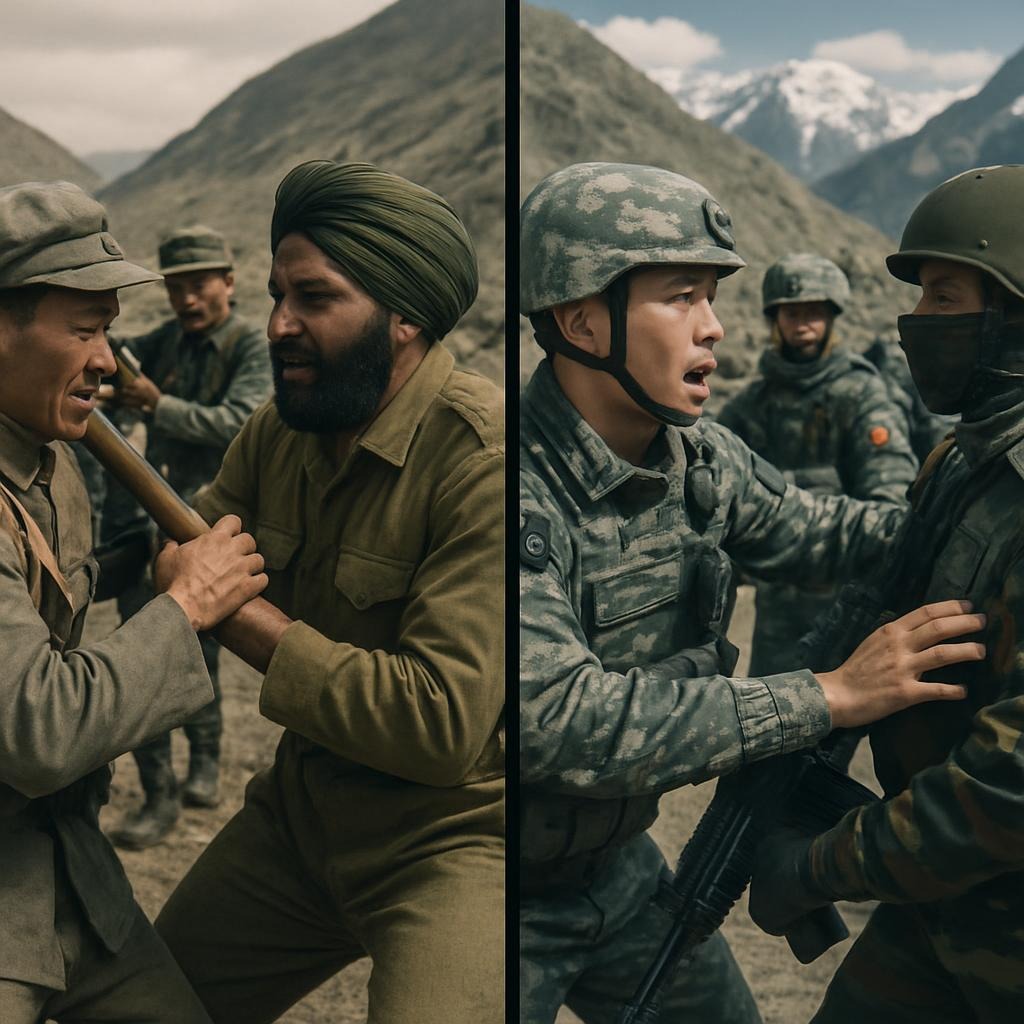
The June 2020 Galwan Valley clash followed Chinese build‑up and forward movement from May 2020 and occurred during an attempted disengagement, when rival patrols confronted each other near newly established positions and differing interpretations of the LAC. Wikipedia csdronline.com The Economic Times Analyses argue Beijing sought to impose a new ground reality along multiple Ladakh points as part of a broader strategy to dominate a changing LAC security environment, making Galwan the first lethal encounter in 45 years. Wikipedia JSTOR csdronline.com
Source: https://en.wikipedia.org/wiki/2020%E2%80%932021_China%E2%80%93India_skirmishes Wikipedia
Keywords: Galwan Valley, 2020–21 skirmishes, disengagement, Ladakh, LAC realignment, PLA build‑up, fatalities
13. Headline: “Salami Slicing” – China’s Incremental Encroachment Strategy to Shift the LAC Status Quo
“Salami slicing” describes Beijing’s use of small, incremental moves—patrol intrusions, tent encampments, road building, naming campaigns—to alter facts on the ground without triggering full‑scale war. Taylor & Francis Online Wikipedia Along the LAC, this includes gradual occupation or denial of patrol access in disputed pockets and infrastructure that normalizes presence, forcing India to either accept the new status quo or escalate at a disadvantage. Taylor & Francis Online Daniel K. Inouye Asia-Pacific Center for Security Studies thetrickyscribe.com
Source: https://en.wikipedia.org/wiki/Chinese_salami_slicing_strategy Wikipedia
Keywords: salami slicing, incremental encroachment, faits accomplis, LAC, grey zone, coercion, territorial revisionism
14. Headline: Siliguri Corridor – 20–22 km “Chicken’s Neck” Whose Loss Would Cut Off India’s Northeast
The Siliguri Corridor is a 20–22 km‑wide strip in northern West Bengal that forms India’s only land connection to its eight northeastern states and is bordered by Nepal, Bangladesh, and close to Bhutan and Tibet’s Chumbi Valley. InsightsIAS Wikipedia In a conflict—especially if China and Pakistan coordinate—pressure on this corridor could threaten India’s ability to reinforce the Northeast, making it one of the most critical vulnerabilities in Indian war planning for the eastern sector. InsightsIAS Wikipedia Times of India The Week
Source: https://en.wikipedia.org/wiki/Siliguri_Corridor Wikipedia
Keywords: Siliguri Corridor, Chicken’s Neck, Northeast connectivity, Chumbi Valley, strategic chokepoint, encirclement risk
15. Headline: BRI–CPEC – Corridor Through Pakistan‑Administered Kashmir That India Sees as a Sovereignty Violation
The China–Pakistan Economic Corridor (CPEC), a flagship of the Belt and Road Initiative, runs from Xinjiang to Gwadar through Gilgit‑Baltistan and other parts of Pakistan‑administered Jammu & Kashmir, territory India claims as its own. Defence Research and Studies dailyparliamenttimes.com New Delhi opposes CPEC and especially its proposed extension into Afghanistan as “unacceptable” interference in its sovereignty and worries that dual‑use infrastructure deepens a hostile China–Pakistan strategic axis on its western flank. Defence Research and Studies Observer Research Foundation | ORF Khaama Press
Source: https://dras.in/india-against-cpec-a-critical-analysis/ Defence Research and Studies
Keywords: CPEC, Belt and Road, Pakistan‑administered Kashmir, Gilgit‑Baltistan, sovereignty violation, China–Pakistan axis
16. Headline: Infrastructure Race – Roads and Airfields That Create a Classic Security Dilemma on the LAC
China has rapidly upgraded roads, military positions, and dual‑use infrastructure from eastern Ladakh to Arunachal, enabling faster PLA mobilization and forward deployment. Observer Research Foundation | ORF Times of India India has responded with its own surge—BRO projects, tunnels, and new airfields—to close the gap, but each side’s “defensive” build‑up is perceived by the other as offensive, trapping them in a security dilemma where more infrastructure paradoxically increases crisis risk. Free Press Journal Observer Research Foundation | ORF reportwire.in
Source: https://www.orfonline.org/research/india-and-china-caught-in-vicious-cycle Observer Research Foundation | ORF
Keywords: border infrastructure, BRO, PLA roads, airfields, security dilemma, LAC militarization, deterrence
17. Headline: Brahmaputra/Yarlung Tsangpo – Shared River That Adds Water Leverage to the Border Rivalry
The Yarlung Tsangpo originates in Tibet, becomes the Brahmaputra in India, and is a lifeline for millions; both China and India are aggressively damming it for hydropower. Springer NDTV China’s plan for a massive upstream mega‑dam near the disputed Arunachal/Tibet border raises Indian fears over flow manipulation, flood risks, and the absence of a binding water‑sharing treaty—turning the river into both a resource competition and a potential instrument of strategic pressure. Springer NDTV cescube.com
Source: https://www.ndtv.com/world-news/how-chinas-risky-dangerous-brahmaputra-mega-dam-could-impact-india-9834965 NDTV
Keywords: Brahmaputra, Yarlung Tsangpo, hydropolitics, mega dam, water security, hydropower, water weaponization risk
18. Headline: Quad Membership – India as Key Indo‑Pacific Balancer Heightening Chinese Suspicion
India’s role in the Quad with the US, Japan, and Australia is widely seen in Chinese discourse as part of a US‑led attempt to contain China in the Indo‑Pacific, especially after more frequent summits and security‑focused communiqués. Springer Universal Group Of Institutions Observer Research Foundation | ORF For Beijing, deeper Indian participation in Quad naval exercises, tech and security initiatives signals that New Delhi is drifting closer to a balancing coalition, reinforcing its perception of India as a strategic rival rather than a neutral neighbor. Springer The Diplomat cnss.org.in
Source: https://link.springer.com/content/pdf/10.1007/s12140-025-09448-0.pdf Springer
Keywords: Quad, Indo‑Pacific, containment, maritime coalition, Chinese perception, strategic alignment, balancing China
19. Headline: ~$100+ Billion Trade Deficit – Structural Economic Dependence That Gives Beijing Leverage
India’s trade deficit with China reached about $99.2 billion in 2024–25 and is projected by some analyses to exceed $100–106 billion in 2025, driven by heavy Indian imports of Chinese electronics, machinery, and intermediate goods. Hindustan Times The Wire The Hindu This structural dependence makes rapid decoupling difficult and gives Beijing potential leverage in crises—through export curbs, standards, or informal boycotts—although India is simultaneously trying to diversify and use selective restrictions to mitigate vulnerability. Hindustan Times India Today The Hindu
Source: https://www.hindustantimes.com/india-news/indias-trade-deficit-with-china-surged-to-record-level-in-2024-25-govt-data-101744804910139.html Hindustan Times
Keywords: trade deficit, imports from China, electronics, economic leverage, interdependence, vulnerability, decoupling attempts
20. Headline: Grey‑Zone Warfare – Chinese Cyber and Disinformation Operations Targeting Indian Grids and Narratives
Investigations have documented state‑linked Chinese hacking groups targeting Indian critical infrastructure, especially the power grid and load‑dispatch centers, since the post‑2020 border tensions. breachspot.com Observer Research Foundation | ORF India’s defence leadership explicitly frames cyberattacks, disinformation campaigns, and economic coercion as grey‑zone tools used below the threshold of open war—forcing New Delhi to harden cyber defences and information space as part of its border strategy. breachspot.com The Economic Times Indian Defence Review
Source: https://www.orfonline.org/expert-speak/expanding-chinese-cyber-espionage-threat-against-india Observer Research Foundation | ORF
Keywords: grey‑zone tactics, cyberattacks, power grid, disinformation, Chinese cyber‑espionage, hybrid warfare, critical infrastructure
III. Future scenarios & geopolitics
21. Headline: Two‑Front War – Low Probability of Full Coordination, High Risk of Parallel Pressure
Analysts judge India remains vulnerable to a dual‑front threat, as deepening China–Pakistan military coordination—from arms transfers to joint exercises—creates potential for parallel crises rather than a fully synchronized joint campaign. Stimson Center sociologyjournal.in India lacks resources for a comfortable two‑front war, so both Beijing and Islamabad can leverage calibrated escalation in one theater to strain India in the other, even if political and nuclear risks make a fully coordinated all‑out assault unlikely. Stimson Center sociologyjournal.in Observer Research Foundation | ORF
Source: https://www.stimson.org/2021/the-challenge-of-a-two-front-war-indias-china-pakistan-dilemma/ Stimson Center
Keywords: two‑front war, China–Pakistan collusion, India vulnerability, parallel crises, deterrence, triadic rivalry
22. Headline: Maritime Shift – Indian Ocean Likely to Become Co‑Equal Theater of Sino‑Indian Rivalry
China’s growing presence in the Indian Ocean—ports, “string of pearls” logistics, naval deployments—has turned the IOR into a crucial arena where its vertical “port‑centric” strategy collides with India’s horizontal, networked maritime posture. sinosoutheastinitiative.com JSTOR Observer Research Foundation | ORF Most assessments see the Himalayas remaining tense, but forecast that over the next decade the Indo‑Pacific sea lanes, choke‑points, and island states will increasingly define the rivalry’s intensity and perhaps overshadow individual land flare‑ups in strategic importance. JSTOR Stimson Center impriindia.com
Source: https://www.orfonline.org/research/jostling-for-primacy-india-s-china-challenge-in-the-indian-ocean Observer Research Foundation | ORF
Keywords: Indian Ocean Region, maritime rivalry, string of pearls, necklace of diamonds, sea lanes, Indo‑Pacific
23. Headline: Dalai Lama Succession – Looming Flashpoint That Could Destabilize Tibet and Border States
The Dalai Lama, now 90, has stated that his reincarnation will be chosen by Tibetan institutions like the Gaden Phodrang Trust and that no external actor has authority—directly rejecting Beijing’s claim to control the process. Observer Research Foundation | ORF South Asia Journal China insists the next Dalai Lama must be approved by the Chinese state, setting up a future dual‑Dalai‑Lama scenario that could inflame Tibetan politics, sharpen India–China tensions over Dharamsala‑based institutions, and heighten security sensitivity in Ladakh and Arunachal Pradesh when succession occurs. Institute for Security and Development Policy India Today Counterpoint
Source: https://www.orfonline.org/research/the-dalai-lama-succession-row-is-china-s-headache-and-india-s-too Observer Research Foundation | ORF
Keywords: Dalai Lama succession, Tibet question, Gaden Phodrang, Chinese control, dual reincarnation, Ladakh, Arunachal
24. Headline: Economic Decoupling – India Can Reduce but Not Quickly Replace Chinese Inputs Despite Make in India
Despite Make in India and Atmanirbhar Bharat, India’s manufacturing ecosystem still relies heavily on Chinese components, especially in electronics and intermediate goods, even as domestic output has grown sharply. India Today Hinrich Foundation ET CFO Policy roadmaps propose restricting low‑end imports and boosting MSMEs, but trade data show dependence is rising in some sectors; realistic scenarios suggest gradual diversification and selective decoupling rather than a clean break in the near term. India Today taxtmi.com ET CFO
Source: https://www.hinrichfoundation.com/research/wp/trade-and-geopolitics/make-in-india-relies-on-made-in-china Hinrich Foundation
Keywords: Make in India, Atmanirbhar Bharat, supply chains, Chinese components, import substitution, MSMEs, partial decoupling
25. Headline: Tech Cold War – AI, 6G and Space Will Deepen but Also Globalize the Sino‑Indian Rivalry
China and India are locked in a widening competition in outer space—where China has a much larger portfolio of offensive and defensive capabilities—and in AI and future 6G ecosystems that underpin economic and military power. Air University Observer Research Foundation | ORF S. Rajaratnam School of International Studies (RSIS) As US–China tech decoupling accelerates, India is positioning itself as an alternative AI and digital hub while worrying about Chinese dominance in space and telecom standards, making technology a core, long‑term arena of strategic rivalry beyond the Himalayas. newspaceeconomy.ca CSIS Observer Research Foundation | ORF
Source: https://www.orfonline.org/research/the-ai-race-positioning-india-and-china-in-a-multipolar-tech-world Observer Research Foundation | ORF
Keywords: AI race, 6G, outer space competition, satellites, dual‑use tech, standards, Indo‑Pacific tech rivalry
26. Headline: Sectoral Swap (Aksai Chin for Arunachal) – Once Floated, Now Politically Toxic on Both Sides
In 1960 Zhou Enlai informally proposed a “package deal”: China would keep Aksai Chin while recognizing Indian control over the eastern sector (today’s Arunachal Pradesh). Business Today Today, with China doubling down on claims to “South Tibet” and India politicizing any territorial concession, analysts widely view such a swap as domestically indefensible in both countries, even though some strategic voices occasionally revive it as a theoretical solution. Business Today Electronic Journal of Social and Strategic Studies DNA India
Source: https://www.businesstoday.in/india/story/aksai-for-arunachal-strike-a-deal-with-china-sushant-sareen-urges-amid-india-us-tensions-488252-2025-08-07 Business Today
Keywords: sectoral swap, Aksai Chin, Arunachal Pradesh, Zhou Enlai proposal, package deal, political viability
27. Headline: India in 2030 – Likely Multi‑Aligned “Swing State” Rather Than Formal Western Ally
Current trajectories show India deepening security and economic ties with Western states while maintaining strategic autonomy and partnerships with Russia and the Global South—what analysts call “multi‑alignment.” Hudson Chatham House The German Marshall Fund of the United States Most assessments expect India in 2030 to act as a pivotal swing state that leans West on China‑related issues but resists binding alliance structures, using its in‑between position to maximize leverage in a fractured, multipolar order. Hudson The Diplomat InsightsIAS
Source: https://www.hudson.org/foreign-policy/indias-multi-alignment-rising-geopolitical-profile-aparna-pande Hudson
Keywords: swing state, strategic autonomy, multi‑alignment, alliance politics, multipolarity, tilting West, non‑Western worldview
28. Headline: Melting Himalayas – Glacier Loss That Will Intensify Water Stress and Raise the Stakes in Border Negotiations
Himalayan glaciers—the “Third Pole”—are melting at accelerating rates, threatening long‑term flows of major rivers like the Ganges, Indus, and Brahmaputra that support over a billion people. Sigma Earth himalayangeographic.com climatecosmos.com In the medium term, more glacial lake outburst floods and flow variability will complicate dam projects and border infrastructure, while long‑term water scarcity could turn shared rivers into even sharper geopolitical bargaining chips in India–China (and regional) negotiations. himalayangeographic.com climatecosmos.com Times Now
Source: https://himalayangeographic.com/the-melting-himalayas-assessing-climate-changes-impact-on-glaciers-water-security/ himalayangeographic.com
Keywords: Himalayan glaciers, Third Pole, water security, GLOFs, river flows, climate change, border bargaining
29. Headline: Nepal, Bhutan, Bangladesh – Buffer States Whose Hedging Will Shape the Sino‑Indian Balance
Nepal and Bangladesh are increasingly arenas of China–India (and US) competition in infrastructure, hydropower, and trade, while Bhutan remains tightly linked to India but under growing Chinese pressure on its border and road projects. Geopolitical Monitor Stimson Center Foreign Policy Research Institute These states are not passive: Nepal in particular hedges between India and China under a non‑alignment posture, and how each of them calibrates its partnerships will either reinforce India’s traditional buffer system or open new corridors for Chinese influence around India’s periphery. Geopolitical Monitor Springer Lee Kuan Yew School of Public Policy
Source: https://www.geopoliticalmonitor.com/nepal-between-giants-india-china-rivalry-in-the-himalayas/ Geopolitical Monitor
Keywords: buffer states, Nepal, Bhutan, Bangladesh, hedging, BRI, hydropower, periphery competition
30. Headline: CBMs for Pre‑2020 Status Quo – Verified Disengagement, Clear Patrolling Regimes, and Crisis Hotlines
India and China already have multiple border agreements, and in 2024 they reached a patrolling arrangement aimed at gradually resuming pre‑2020 patterns in some sectors. Ministry of External Affairs, Government of India The Economic Times To return more fully to the pre‑Galwan status quo, experts and officials point to the need for: complete verified troop disengagement at remaining friction points, expanded buffer zones, clearer and jointly mapped patrolling protocols, robust hotlines and flag‑meet mechanisms, and updated confidence‑building measures being discussed in new boundary talks to prevent sudden flare‑ups. Ministry of External Affairs, Government of India The Economic Times Deccan Herald Chatham House
Source: https://economictimes.indiatimes.com/news/defence/india-china-border-patrol-agreement-explained-why-it-matters/articleshow/114451237.cms The Economic Times
Keywords: confidence‑building measures, disengagement, patrolling agreement, buffer zones, hotlines, pre‑2020 status quo, border talks
About the Author