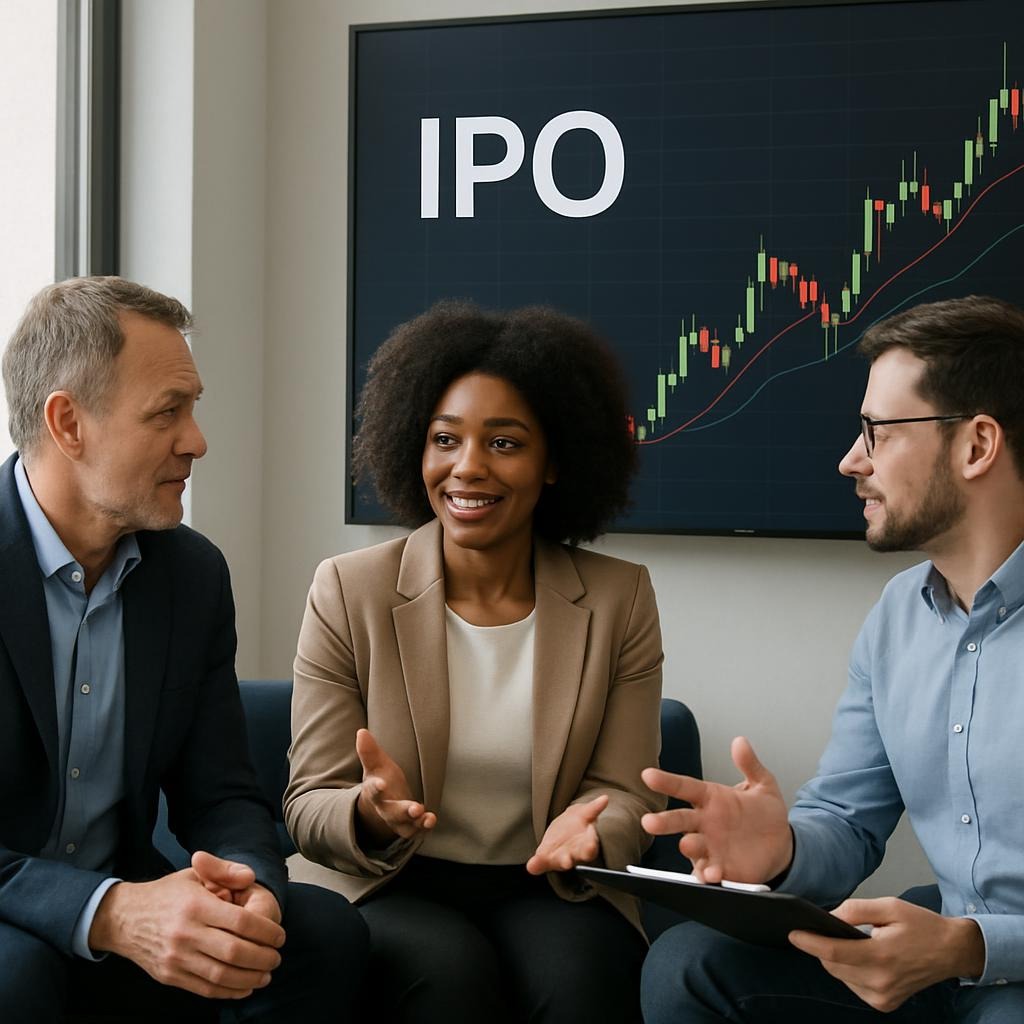
An AI-generated illustration of investors discussing IPO investing.
Basics of IPOs
What is an IPO, and why do companies choose to go public? An IPO is the first sale of a private company’s shares to the public; companies go public to raise capital, provide liquidity for early investors and employees, and gain visibility and credibility Investopedia. Link: https://www.investopedia.com/terms/i/ipo.asp
How does the IPO process differ from private fundraising? IPOs sell shares to the public under strict disclosure and regulatory regimes, while private fundraising targets accredited investors with fewer disclosure requirements and greater flexibility over terms Investopediaspacexstock.com. Link: https://www.investopedia.com/ask/answers/021015/what-difference-between-ipo-and-private-placement.asp
What role do underwriters play in an IPO? Underwriters (investment banks) help value the company, manage regulatory filings, market the offering, build the order book, set the offer price, and stabilize trading after listing InvestopediaSoFi. Link: https://www.investopedia.com/ask/answers/041415/what-does-underwriter-do-new-stock-offering.asp
How is the initial share price determined? Offer prices are set through valuation analysis, investor demand from the roadshow/book-building, market conditions, and peer comparisons, negotiated between the issuer and underwriters InvestopediaSoFilegalclarity.org. Link: https://www.investopedia.com/articles/financial-theory/11/how-an-ipo-is-valued.asp
What is the difference between a traditional IPO and a direct listing? Traditional IPOs issue new shares and use underwriters to set an offer price; direct listings list existing shares without raising new capital or using underwriters to price the stock, leaving price discovery to the market InvestopediaDonnelley Financial SolutionsWall Street Prep. Link: https://www.investopedia.com/investing/difference-between-ipo-and-direct-listing/
Investment considerations
What are the main risks of investing in IPOs? Key risks include overvaluation, high volatility post-listing, limited historical data, and supply shocks from insider lock-up expirations hdfcsky.comOptions Trading IQ. Link: https://hdfcsky.com/sky-learn/ipo/risks-of-investing-in-ipos
Why are IPOs often considered more volatile than established stocks? New listings face uncertain price discovery, uneven liquidity, sentiment-driven trading, and limited public track records compared to seasoned companies infomediang.commoneypulses.com. Link: https://infomediang.com/upcoming-ipos-vs-established-stocks-where-should-you-invest/
How can investors evaluate whether an IPO is overvalued or undervalued? Compare valuation multiples (P/E, EV/Sales), margins, growth, and unit economics to peers, and read the prospectus to assess the use of proceeds, risks, and governance disclosures markets.comBoston Institute of Analytics. Link: https://www.markets.com/education-centre/how-to-evaluate-an-ipo/
What financial metrics should be analyzed before investing in an IPO? Focus on EPS, P/E, ROE, debt-to-equity, and free cash flow to assess profitability, leverage, and cash generation relative to peers and the growth plan LAFFAZblog.trillionize.com. Link: https://laffaz.com/key-metrics-to-evaluate-before-applying-for-an-ipo/
How important is the company’s growth story in IPO investing? A clear, credible equity story aligned to long-term strategy and fundamentals improves investor confidence and supports sustained performance beyond the listing McKinsey & CompanyPwC. Link: https://www.mckinsey.com/capabilities/strategy-and-corporate-finance/our-insights/the-equity-story-you-need-for-the-long-term-investors-you-want
Market dynamics
Why do some IPOs “pop” on the first day of trading? First-day “pops” often reflect underpricing relative to demand, retail enthusiasm, and order imbalance at the open versus the set offer price SoFiNasdaq. Link: https://www.sofi.com/learn/content/ipo-pop/
What factors cause IPOs to underperform after listing? Post-IPO underperformance can stem from optimistic pricing, execution challenges, shifting market conditions, and a pivot from growth narratives to scrutiny of earnings and governance thefinancialanalyst.netBain & Company. Link: https://thefinancialanalyst.net/2025/05/19/ipos-long-term-lag-why-stocks-often-struggle-post-listing/
How does market sentiment affect IPO success? Positive sentiment boosts demand and pricing; negative sentiment depresses subscription and aftermarket performance, with macro conditions and volatility strongly shaping outcomes EYblog.trillionize.com. Link: https://www.ey.com/en_jp/newsroom/2025/10/global-ipo-market-surges-amid-rising-investor-confidence-in-q3-2025
What role does institutional investor demand play in IPO pricing? Institutional demand discovered in book-building influences final pricing and allocations; strong institutional interest can anchor pricing and stabilize trading JSTORblog.trillionize.com. Link: https://www.jstor.org/stable/30225701
How do lock-up periods impact stock performance after an IPO? When lock-ups expire, insider selling can increase float and pressure prices; lock-ups initially stabilize markets by limiting immediate insider sales InvestopediaSoFi. Link: https://www.investopedia.com/terms/l/lockup-period.asp
Strategy and timing
Should retail investors buy IPO shares at the offering price or wait until after listing? Most retail investors don’t access the offer price; waiting allows observing price discovery, fundamentals, and early trading behavior before committing NerdWalletFinanceBuzz. Link: https://www.nerdwallet.com/investing/best/brokers-for-ipo-access
How can investors access IPO shares before they start trading publicly? Access routes include participating via brokers with IPO programs, private placements, secondary markets for private shares, or pre-IPO platforms, often with eligibility constraints Stock AnalysisUpMarket. Link: https://stockanalysis.com/article/how-to-buy-pre-ipo-stock/
Is it better to invest in IPOs during bull markets or bear markets? Bull markets tend to improve pricing and aftermarket support, while bear markets increase risk and reduce demand; timing should align with valuation discipline, not just sentiment blog.trillionize.comInvestopedia. Link: https://blog.trillionize.com/comparing-ipos-in-bull-and-bear-markets/
What strategies can help mitigate risks when investing in IPOs? Mitigate risk by scrutinizing the prospectus, comparing peer valuations, sizing positions modestly, staggering entry post-lock-up, and diversifying across sectors and stages Investopediahdfcsky.com. Link: https://www.investopedia.com/investing/tips-for-investing-in-ipos/
How does diversification apply to IPO investing? Treat IPOs as a satellite allocation within a diversified portfolio, spreading exposures across sectors, geographies, and listing cohorts to reduce idiosyncratic risk easystreetinvesting.comquiketalk.com. Link: https://www.easystreetinvesting.com/incorporating-ipos-into-your-diversification-strategy/
Global and sector perspectives
How do IPO regulations differ across countries? Regulatory frameworks, disclosure standards, listing rules, and offering processes vary widely across jurisdictions, affecting timelines, costs, and investor protections Global Legal InsightsLatham & Watkins LLPEY. Link: https://www.globallegalinsights.com/practice-areas/initial-public-offerings-laws-and-regulations/
Why are tech IPOs often more hyped than other sectors? Tech IPOs promise scalable growth, network effects, and innovation, attracting attention and richer multiples—though hype can disconnect prices from fundamentals bscapitalmarkets.comInvestor’s Business Daily. Link: https://www.bscapitalmarkets.com/tech-ipos-boom-are-they-really-worth-the-hype.html
What lessons can be learned from famous IPO successes like Google or Amazon? Successes highlight disciplined pricing, strong governance, clear use of proceeds, and long-term reinvestment into growth engines and acquisitions post-IPO Harvard Business ReviewTransworld Business Advisors. Link: https://hbr.org/2010/05/how-i-did-it-googles-ceo-on-the-enduring-lessons-of-a-quirky-ipo
What lessons can be learned from IPO failures like WeWork? Weak governance, founder overreach, opaque metrics, and misaligned unit economics can derail listings; robust governance and realistic narratives are essential directors-institute.comThe Corporate Governance Institute. Link: https://www.directors-institute.com/post/the-wework-collapse-governance-failures-founder-control-lessons-learned
How do SPACs compare to IPOs? SPACs can be faster and offer price certainty but often involve dilution and post-merger volatility; IPOs provide stricter disclosures and typically greater market credibility KPMGdata-rooms.orgDealRoom. Link: https://kpmg.com/us/en/articles/2022/why-choosing-spac-over-ipo.html
Long-term outlook
Do IPOs generally outperform the market in the long run? Evidence shows many IPOs underperform peers over 3–5 years, though outliers exist; two-thirds underperformed established peers in Bain’s analysis Bain & Companythefinancialanalyst.net. Link: https://www.bain.com/insights/how-to-avoid-the-curse-of-ipo-underperformance-snap-chart/
How can investors distinguish between short-term hype and long-term potential? Prioritize fundamentals over narrative: unit economics, cash flow path, governance quality, and peer-relative valuation versus media momentum or first-day pops Analytics InsightInvestopedia. Link: https://www.analyticsinsight.net/finance/how-to-identify-speculation-vs-investment-easy-ipo-guide
What role does corporate governance play in IPO success? Strong boards, transparent reporting, and shareholder-aligned structures build trust and improve post-IPO performance and resilience EYPwC. Link: https://www.ey.com/content/dam/ey-unified-site/ey-com/en-gl/insights/growth/documents/ey-guide-to-going-public.pdf
How do IPOs affect existing shareholders and employees? Existing shareholders may face dilution or realize liquidity; employees can gain wealth via options but often experience cultural shifts and changing pay practices after listing financestuCLS Blue Sky BlogWillis Towers Watson. Link: https://financestu.com/what-happens-to-existing-shareholders-in-an-ipo/
Should IPO investing be part of a long-term portfolio strategy or treated as speculative? IPOs should be a measured, diversified satellite exposure with strict valuation and risk controls; short-term trading leans speculative, long-term investing demands fundamentals-based discipline blog.trillionize.comInvestopedia. Link: https://blog.trillionize.com/long-term-vs-short-term-ipo-investments/
Global and sector: regulations, governance, tech IPOs, SPAC vs IPO, cross-border listings
Long-term: corporate governance, employee impact, dilution, fundamentals vs hype
Documentary list with links
Inside Job (2010): Examines market incentives and governance failures relevant to IPO cycles https://www.sonyclassics.com/insidejob/
Enron: The Smartest Guys in the Room (2005): Cautionary tale on corporate governance and disclosure https://www.amazon.com/Enron-Smartest-Guys-Room/dp/B0009NZ6JW
The China Hustle (2018): Due diligence, cross-border listings, and investor protection themes https://www.netflix.com/title/81026361
WeWork: Or the Making and Breaking of a $47 Billion Unicorn (2021): Governance and hype lessons https://www.hulu.com/movie/wework-or-the-making-and-breaking-of-a-47-billion-unicorn
The Rise of Wall Street (2020): History of investment banking, underwriting, and market evolution https://www.amazon.com/Rise-Wall-Street/dp/B0876J4F4K
Capitalism: A Love Story (2009): Broad market dynamics and sentiment cycles impacting listings https://www.amazon.com/Capitalism-Love-Story-Michael-Moore/dp/B0031ZDSE6
The Ascent of Money (2008): Foundations of capital markets, equity financing, and public listings https://www.amazon.com/Ascent-Money-Niall-Ferguson/dp/B00F1N9Y2I
Betting on Zero (2016): Short vs long-term narratives and the role of research vs hype https://www.netflix.com/title/80109416
Dirty Money (Season 1–2): Corporate misconduct, governance red flags, and investor protection https://www.netflix.com/title/80118100
The Big Short (2015): Market sentiment, mispricing, and risk management under uncertainty https://www.netflix.com/title/80075533